101 AI Search and Local Business Statistics for 2026
Updated November 2026
Google says AI Overviews have over 2.5 billion monthly active users. For a local business the bigger question is narrower: when someone asks an AI tool for a plumber or a roofer, who gets named, and does anyone still click?
The honest answer is that the data is young and the studies disagree. So this page does three things. It gives each official user count with what it actually measures. It shows every major click study with its method and date. And it separates the local-specific numbers from the general ones, because most AI search research is not about local businesses at all.
Every number is linked to the group that produced it and dated. This page is part of our local data section; the main page is local search statistics.
Key Takeaways
- 49% of US adults use AI chatbots, up from 33% in 2024, and 24% use them daily (Pew Research Center, Americans and AI 2026, Jun 2026).
- Google's AI Mode passed 1 billion monthly active users (Alphabet, Q2 2026 earnings remarks, Jul 2026).
- AI Overviews appeared on 15% of local-intent searches but 92% of informational ones (Whitespark, The Prevalence of AI Overviews in Local Search, May 2025).
- Google users clicked a traditional result on 8% of visits with an AI summary, against 15% without one (Pew Research Center, AI summaries and clicks, Jul 2025).
- When a brand was cited in the AI Overview its organic click-through rate was 2.07%, against 0.94% when it was not cited (Seer Interactive, AIO Impact on Google CTR: 2026 Update, Apr 2026).
- The share of consumers using AI to find a local business in the last 30 days rose from 9% to 52% in a year (SOCi, 2026 Local Discovery Index, Nov 2026).
- Only 18% of consumers felt ready to contact a business an AI tool recommended (BrightLocal, Consumer Search Behavior 2026 part 2, Jul 2026).
- Google Business Profile made up 28.5% of all citations in 1.9 million local AI citations (BrightLocal, Top sources and directories for local AI search, Aug 2026).
- ChatGPT recommends just 1.2% of brand locations, against 35.9% that appear in Google's local 3-pack (SOCi, 2026 Local Visibility Index, Jan 2026).
- Google Maps mentioned a tracked business in 66% of searches, against 32-38% for AI surfaces (BrightLocal, What 200k local AI searches tell us, Sep 2026).
- 86% of AI citations for brands came from sources the brand manages, such as its website and listings (Yext, 86% of AI Citations Come from Brand-Managed Sources, Oct 2025).
- 19.8% of US businesses used AI in early May 2026, and fewer than 20% of firms with four or fewer employees did (U.S. Census Bureau, AI Use at U.S. Businesses, May 2026).
How many people use AI search and AI assistants?
The audience is already enormous, but the companies count it in different ways. Add the numbers together and you count the same person three or four times.
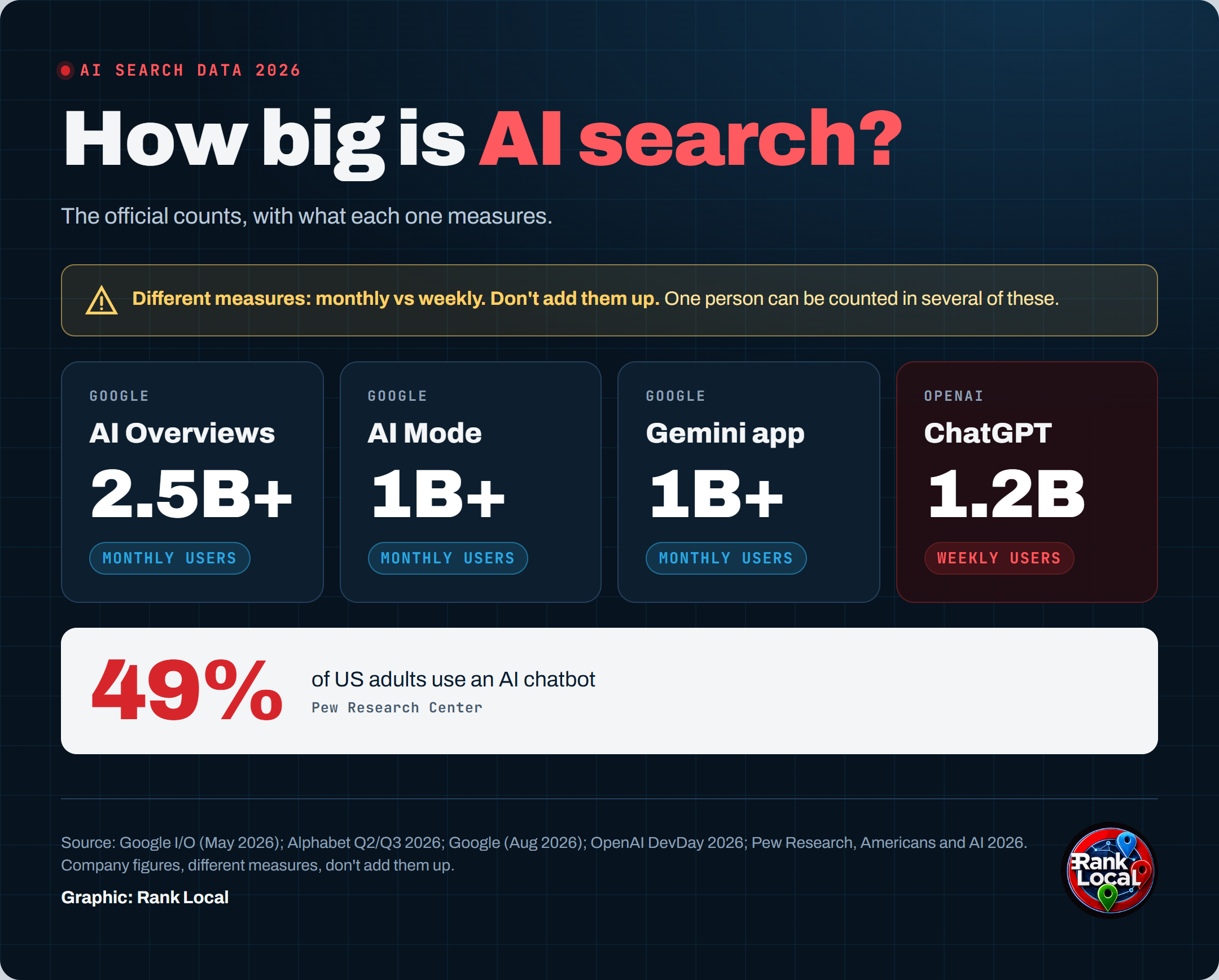 Figure 1: The official user counts side by side, with what each one measures. Monthly and weekly counts are not the same thing, and one person can sit in all four. Source: Google, I/O 2026 keynote, May 2026 (AI Overviews 2.5B+ monthly); Alphabet, Q2 2026 earnings remarks, Jul 2026 (AI Mode 1B+ monthly); Google, Gemini app one billion monthly users, Aug 2026 (Gemini app 1B+ monthly); OpenAI, DevDay 2026 Recap, Sep 2026 (ChatGPT 1.2B weekly); Pew Research Center, Americans and AI 2026, Jun 2026 (49% of US adults). Graphic by Rank Local from those sources.
What are the official user counts?
- AI Overviews: "over 2.5 billion monthly active users" (Google, I/O 2026 keynote, May 2026).
- Google says AI Mode reached one billion monthly users one year after its debut, with queries more than doubling every quarter since launch (Google, A new era for AI Search, May 2026).
- The Gemini app passed 1 billion monthly users, and 63% of users now talk directly to Gemini (Google, More than 1 billion people are using the Gemini app every month, Aug 2026).
- ChatGPT: "our collective 1.2B weekly users" (OpenAI, DevDay 2026 Recap, Sep 2026). In February OpenAI had reported more than 900M weekly active users and more than 50 million consumer subscribers (OpenAI, Scaling AI for everyone, Feb 2026).
- Queries in AI Mode are on average three times longer than traditional searches, and one in five AI Mode searches globally use voice, images or documents (Alphabet, Q3 2026 earnings remarks, Oct 2026).
Which chatbots do Americans use?
- 44% of US adults use ChatGPT, 24% Gemini, 17% Copilot and 6% Claude, and six in ten say they read AI search summaries (Pew Research Center, Americans and AI 2026, Jun 2026).
- 64% of US teens ages 13 to 17 use AI chatbots, about three in ten daily, and 59% use ChatGPT (Pew Research Center, Teens, Social Media and AI Chatbots 2025, Dec 2025).
- In September 2026 ChatGPT had 56.4% of worldwide generative AI website visits, Gemini 25.0% and Claude 9.6%. A year earlier ChatGPT had 71.8% and Gemini 13.6% (Similarweb, Gen AI website traffic share update, September 2026, Oct 2026).
- Visits to generative AI platforms averaged 9.5 billion a month between June 2025 and May 2026, up 70% year over year, from 655 million unique visitors (Similarweb, AI Search Stats 2026, Jul 2026).
- In Pew's browsing panel, 13% of US adults visited an AI chatbot website during March 2025, and 20% of those ages 18 to 29 did (Pew Research Center, What web browsing data tells us about how AI appears online, May 2025).
- Users over 45 accounted for nearly 30% of generative AI usage in 2025, a sign it has spread beyond early adopters (Similarweb, 2025 Generative AI Landscape press release, Dec 2025).
- The share of ChatGPT users who also use Google stayed at 95% from September 2025 to May 2026, so AI is being added to search habits, not replacing them (Similarweb, Is AI Replacing Search?, Aug 2026).
What do people use AI for?
- OpenAI says more than 1 billion people are putting ChatGPT to work, and multimedia makes up 7.8% of messages (OpenAI, From asking to doing, Aug 2026).
- By July 2025 ChatGPT had been adopted by around 10% of the world's adults, and non-work messages grew from 53% to more than 70%. Some of the paper's authors work at OpenAI (NBER Working Paper 34255, How People Use ChatGPT, Sep 2025).
- About half of ChatGPT messages (49%) are "Asking", seeking information or advice, and three-quarters of conversations are practical guidance, seeking information or writing (OpenAI, How people are using ChatGPT, Sep 2025).
- On Claude.ai, personal use rose from 35% to 42% of conversations, including more product comparisons and home maintenance questions (Anthropic, Economic Index report, Mar 2026).
- In 37.5 million Copilot conversations, health was the top topic on mobile in every month and at every hour, and advice-seeking rose through the year (Microsoft AI, The Copilot Usage Report 2025, Dec 2025).
- In an August 2024 survey, 39.4% of US adults ages 18 to 64 had used generative AI, and 28% of workers used it for their job (NBER, Workplace Adoption of Generative AI, Dec 2024).
How many workers and businesses use AI?
- 21% of US workers say at least some of their work is done with AI, up from 16% a year earlier (Pew Research Center, About 1 in 5 US workers now use AI in their job, Oct 2025).
- Among US firms using AI, Sales and Marketing is the most common function they use it for (52%), followed by Strategy and Business Development (45%) (U.S. Census Bureau, The Microstructure of AI Diffusion, Apr 2026).
- 52% of US employees now use AI in their role, 15% daily, and search or research (49%) is the second most common use after writing (Gallup, Organizational AI Adoption Jumps Six Points, Jul 2026).
- AI use is far higher in big firms: 37% of firms with at least 250 employees used AI, and 32% of firms with 100 to 249 employees (U.S. Census Bureau, AI Use at U.S. Businesses, May 2026).
How often do AI answers show on local searches?
It depends on what the person types. Searches for someone to hire mostly still get a map. Questions get an AI answer.
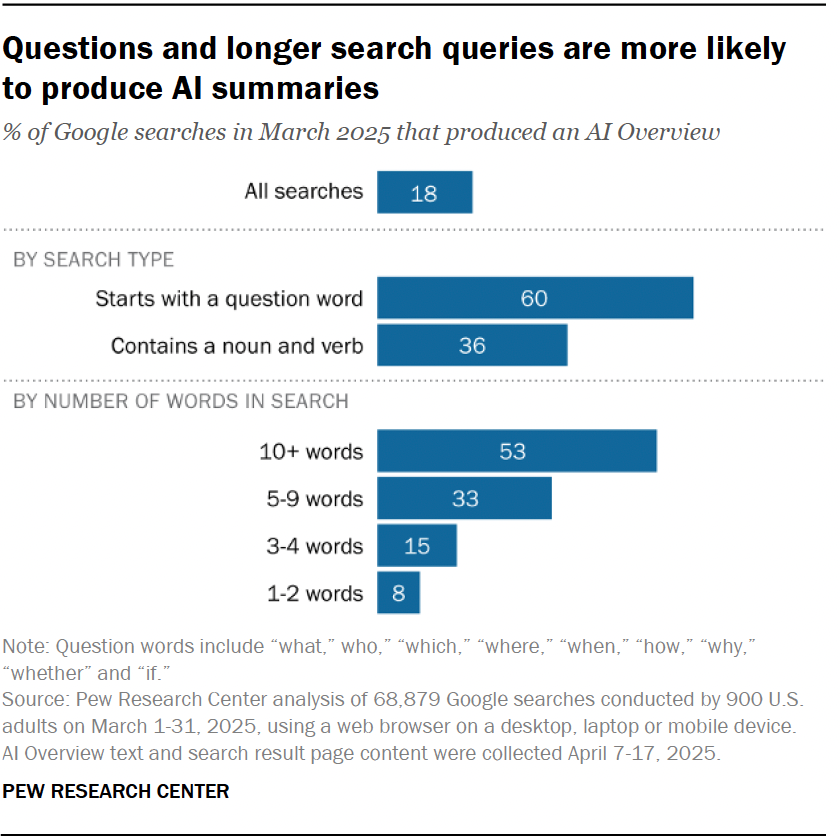 Figure 2: The longer and more question-like the search, the more likely Google answers it with AI. Just 8% of one- or two-word searches got an AI summary, against 53% of searches of 10 words or more. Short "service plus town" searches are the ones that still get a map. Source: Pew Research Center, Google users are less likely to click on links when an AI summary appears, Mar 2025 (data). Chart published by the source.
How often do AI Overviews show on searches overall?
- In Pew's panel of real searches, 18% produced an AI summary, and 60% of searches that began with question words like "who" or "why" got one (Pew Research Center, AI summaries and clicks, Jul 2025).
- 58% of the 900 people in Pew's browsing panel ran at least one search in March 2025 that produced an AI summary (Pew Research Center, What web browsing data tells us about how AI appears online, May 2025).
- AI Overviews showed for 12.8% or more of all Google searches by volume, and only 6.85% of the keywords that triggered one were local (Ahrefs, Insights From 55.8M AI Overviews, May 2025).
- Across 10 million+ keywords, AI Overviews showed on 6.49% in January 2025, nearly 25% in July and 15.69% in November (Semrush, AI Overviews Study, Dec 2025).
- AI Overviews appeared for 30% of US desktop keywords in September 2025, but on just 0.01% of local keywords (seoClarity, Impact of Google's AI Overviews, Oct 2025).
- Similarweb puts the US AI Overview appearance rate at 43%+ of searches (Similarweb, AI Search Stats 2026, Jul 2026).
What does the local research say?
- In a hand-checked study of 540 searches, AI Overviews appeared on 68% of local business-type searches on average, and on 97% of mixed searches. The local pack appeared on 93% of local-intent searches, 6% of informational and 17% of mixed (Whitespark, The Prevalence of AI Overviews in Local Search, May 2025).
- Informational searches containing "near me" showed an AI Overview 76.9% of the time, and roughly 1 in 3 informational searches now shows one (Seer Interactive, AIO Impact on Google CTR: 2026 Update, Apr 2026).
- In 60,000 local business queries, AI Overviews appeared on 40.2%. Informational queries triggered one 58.3% of the time, commercial ones 17.2%, and queries naming a place 35.0% against 46.1% without (Local Falcon, The Impact of Google AI Overviews on Local Business Search Visibility, May 2025).
- Service businesses saw the most AI Overviews in that study: cleaning services 65.0% of queries, legal services 62.1% (Local Falcon, The Impact of Google AI Overviews on Local Business Search Visibility, May 2025).
- In 739 searches across home services, auto service and other verticals, 13% showed only an AI Overview, 23% only a map pack, and "near me" searches triggered a map pack 100% of the time (DAC, AI Overviews vs. the Maps Pack, Aug 2025).
- 13.49% of queries in Google AI Mode included a local pack (Semrush, Google AI Mode vs. Traditional Search, Jul 2025).
These studies count different query sets, so they don't contradict each other as much as it looks. They are not one number.
What happens to clicks when an AI Overview shows?
Every major study finds fewer clicks when an AI Overview shows. The more useful finding for a business is the gap between being cited in the answer and being left out of it.
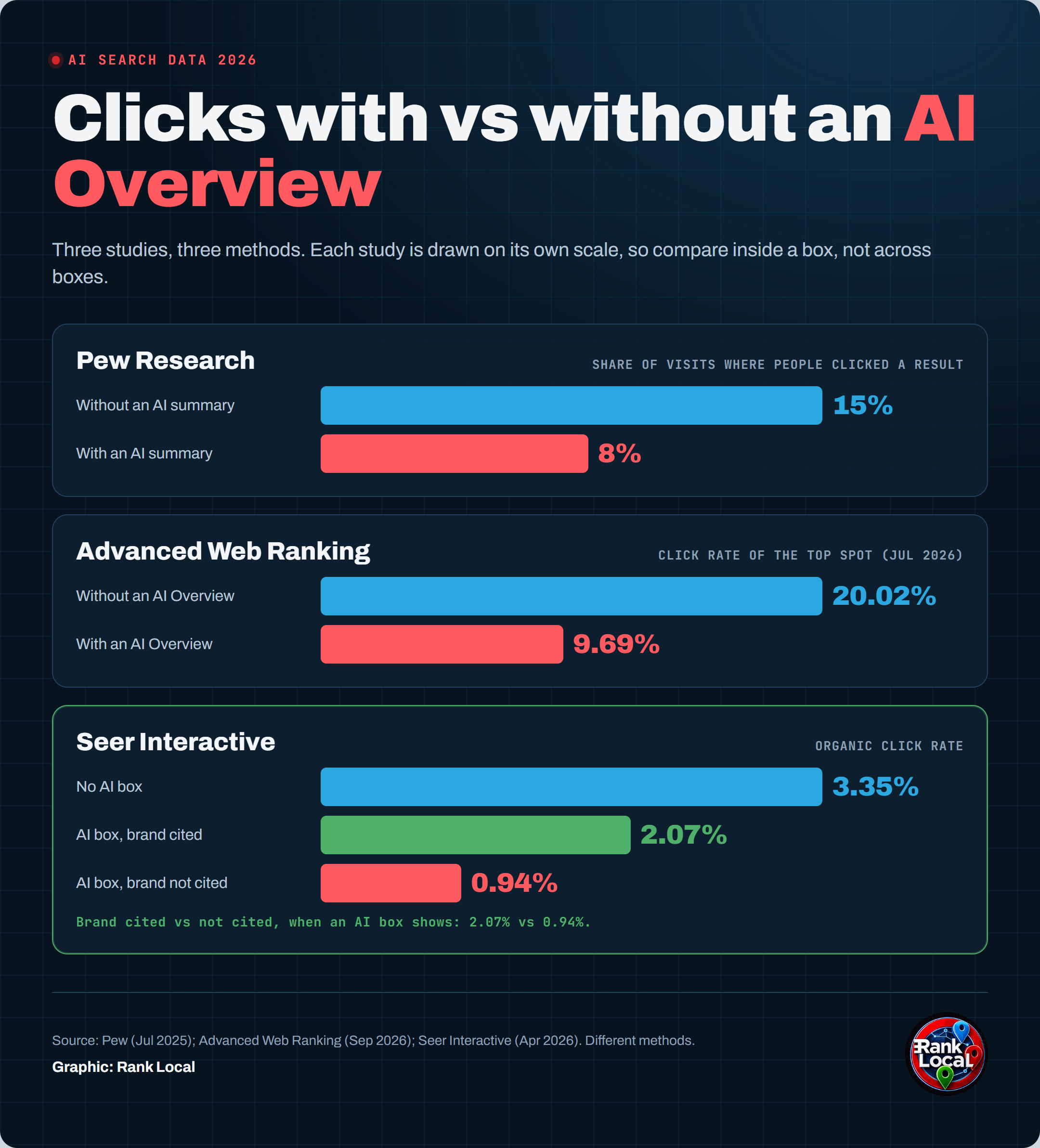 Figure 3: Three studies, three methods, the same direction. Each panel is on its own scale because the studies measure different things. Source: Pew Research Center, AI summaries and clicks, Jul 2025 (15% vs 8%); Advanced Web Ranking, Google Organic CTR by Position 2026, Sep 2026 (20.02% vs 9.69%); Seer Interactive, AIO Impact on Google CTR: 2026 Update, Apr 2026 (3.35%, 2.07%, 0.94%). Graphic by Rank Local from those sources.
What did measured studies find?
- People clicked a link inside the AI summary on just 1% of visits, and ended their browsing session on 26% of visits with a summary against 16% without (Pew Research Center, AI summaries and clicks, Jul 2025). A follow-up paper by Pew authors found the pattern holds after controlling for panelist and query (Pew Research Center authors, arXiv 2608.04831, Aug 2026).
- On US desktop results in July 2026, zero-click rates were 74.3% with an AI Overview and 53.6% without (Advanced Web Ranking, Google Organic CTR by Position 2026, Sep 2026).
- Across 53 brands and 5.47 million queries, Seer measured organic click-through with and without an AI Overview, and with and without the brand cited in it (Seer Interactive, AIO Impact on Google CTR: 2026 Update, Apr 2026).
- In the first four months of 2026, 68.01% of US Google searches ended without a click, up from 60.45% in 2024. Only 0.34% of searches went on to AI Mode (SparkToro, In 2026, Less than One Third of Google Searches Still Send a Click, Jun 2026).
Is the click loss getting worse?
- Ahrefs measured a 34.5% lower click-through rate for the top page in March 2025 (Ahrefs, AI Overviews Reduce Clicks by 34.5%, Apr 2025) and a 58% lower rate in its December 2025 update, where position 1 CTR went from 0.073 to 0.016 (Ahrefs, AI Overviews Reduce Clicks by 58%, Feb 2026). Both are desktop data on general keywords.
- Google says its AI features send "billions of clicks to websites every week" (Alphabet, Q2 2026 earnings remarks, Jul 2026).
How much traffic do AI tools send?
- AI platforms sent more than 1.1 billion referral visits in June 2025, up 357% in a year, and AI referrals to transactional sites converted at about 7% (Similarweb, 2025 Generative AI Landscape press release, Dec 2025).
- AI platforms drove an average of 770.7 million referral visits a month worldwide between June 2025 and May 2026, up 117.4% (Similarweb, AI Referral Traffic by Industry, Sep 2026).
- For digital marketing and SEO topics, the average visitor from an AI search tool was worth 4.4 times a traditional organic visitor, based on conversion rate (Semrush, We Studied the Impact of AI Search on SEO Traffic, Jul 2025).
- For one large multi-location client, ChatGPT traffic went from 0.1% of Google's to 2% in a year, still only 22% of what Bing sent (Sterling Sky, Local SEO Updates 2026, Oct 2026).
How many consumers use AI to find a local business?
The jump in a single year is the biggest change in local search we track. But AI is mostly a research step for now, not where people decide.
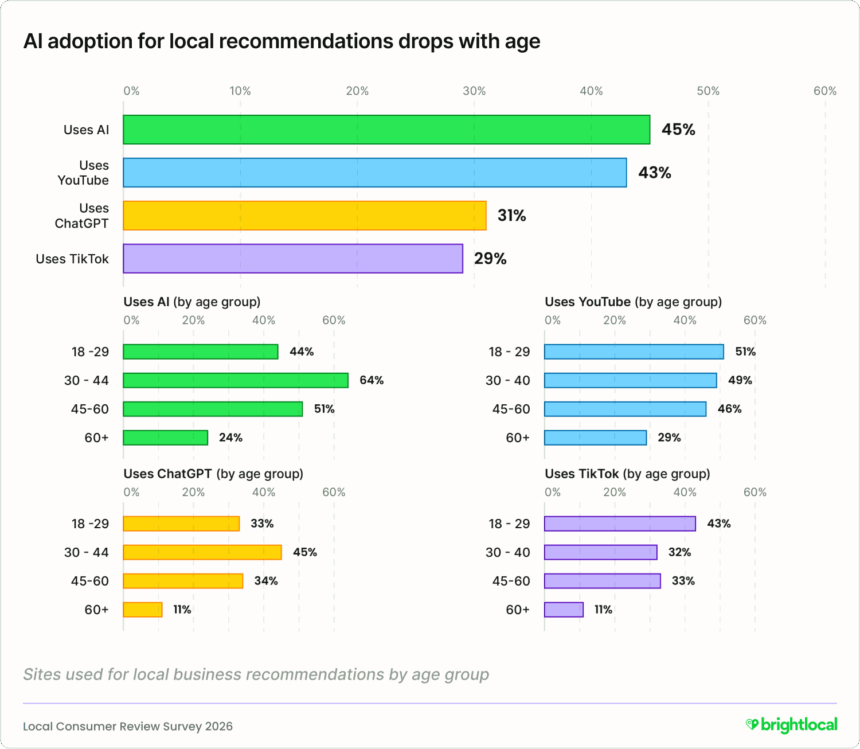 Figure 4: AI is now a mainstream source of local recommendations, but not for everyone. Use peaks at 64% among 30 to 44 year olds and drops to 24% for people over 60, so the customers most likely to find a business through AI are the ones in their prime hiring years. Source: BrightLocal, Nearly Half of Consumers are Asking AI for Business Recommendations, Mar 2026. Chart published by the source.
How fast is AI use for local searches growing?
- About four in ten US adults use chatbots to search for information, the most common use Pew asked about (Pew Research Center, Americans and AI 2026, Jun 2026).
- The share of consumers using AI for local recommendations climbed from 6% in 2025 to 45%. 31% used ChatGPT and 23% Google AI Mode (BrightLocal, Nearly Half of Consumers are Asking AI for Business Recommendations, Mar 2026).
- In 2025, 40% of consumers said they were "actively" using generative AI within search (BrightLocal, Consumer Search Behavior 2025, Apr 2025).
- 68% of consumers had used ChatGPT to research local products or services, and 43% use AI search tools daily or more (Yext, The Rise of AI Search Archetypes, Jul 2025).
Where does AI fit in a local search?
- Only 8% chose an AI tool first for their latest local search, 23% used AI somewhere in it, and 31% use AI monthly for local recommendations (BrightLocal, Consumer Search Behavior 2026 part 2, Jul 2026).
- Of consumers who used AI to find a local business, 57% used ChatGPT and 51% Gemini, and 51% saw an AI answer at the top of Google (SOCi, 2026 Local Discovery Index, Nov 2026).
- 57% of US teens have used chatbots to search for information (Pew Research Center, How Teens Use and View AI, Feb 2026).
These surveys asked different questions over different time windows, which is why 8%, 45% and 52% can all be true at once.
Do people trust AI recommendations, or check them?
People use AI to make a shortlist, then go and check it. That makes the Business Profile, the reviews and the website more important, not less.
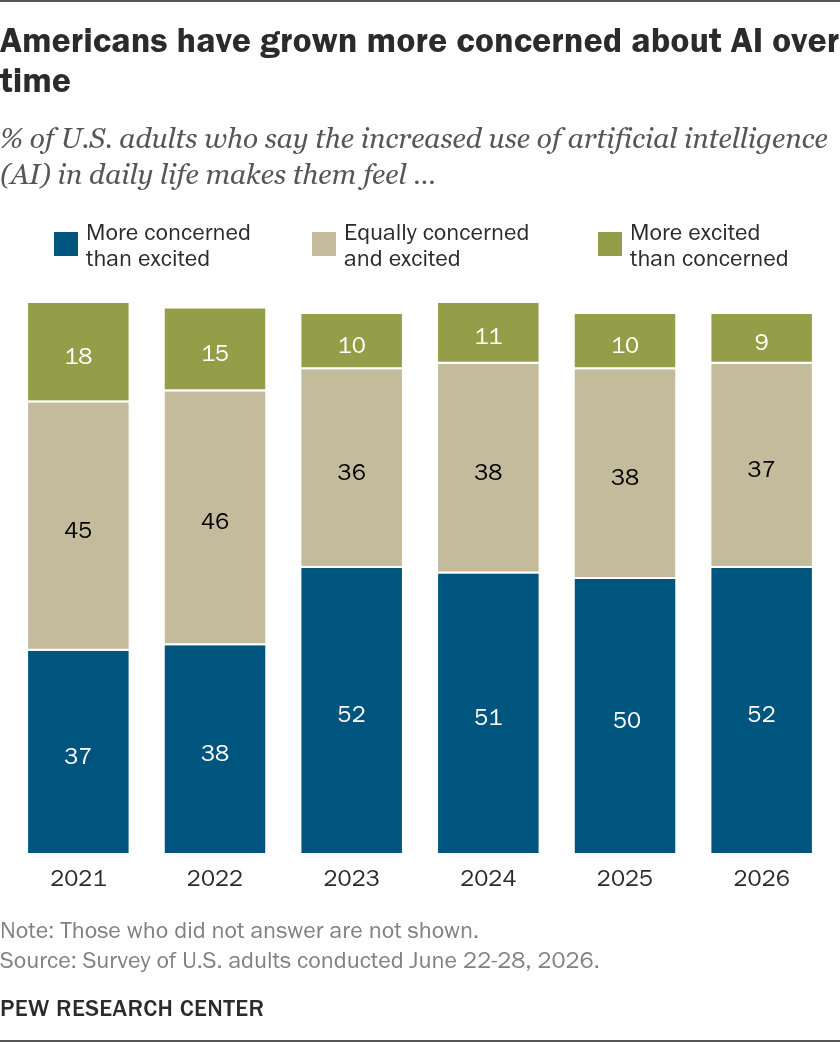 Figure 5: The public mood is cautious, and it is getting more cautious. 52% of Americans are now more concerned than excited about AI in daily life, up from 37% in 2021. A business that an AI tool names still has to earn the customer's trust on its own pages. Source: Pew Research Center, Young adults in the US are increasingly wary of AI, Jun 2026 (data). Chart published by the source.
How do Americans feel about AI?
- For the first time, a majority of adults under 30 (55%) say they are more concerned than excited about AI (Pew Research Center, Young adults in the US are increasingly wary of AI, Aug 2026).
- 40% of consumers trust AI platforms to provide business recommendations, against 32% who don't, and 42% trust them as much as traditional reviews (BrightLocal, Local Consumer Review Survey 2026, Feb 2026).
- Only 19% trust AI search tools over traditional search engines (45%) for local search (Yext, The Rise of AI Search Archetypes, Jul 2025).
How often is AI wrong about local businesses?
- 67% of AI users have been given wrong information about a local business at least once, 81% verify before contacting a business, and only 19% go straight to contact (SOCi, 2026 Local Discovery Index, Nov 2026).
Do people double-check what AI tells them?
- 88% of AI users fact-check its recommendations and 97% sometimes double-check, while 63% say they trust AI recommendations (BrightLocal, Nearly Half of Consumers are Asking AI for Business Recommendations, Mar 2026).
- Just 10% of AI search users trust the first result, and 48% cross-check answers across platforms (Yext, The Rise of AI Search Archetypes, Jul 2025).
- 82% of consumers read AI-generated review summaries, but only 23% would rely on the summary alone (BrightLocal, Local Consumer Review Survey 2026, Feb 2026).
Which sources does AI cite for local businesses?
AI tools mostly repeat what a business already publishes about itself: its profile, its listings and its website. Directories still matter, because that is where AI goes to check.
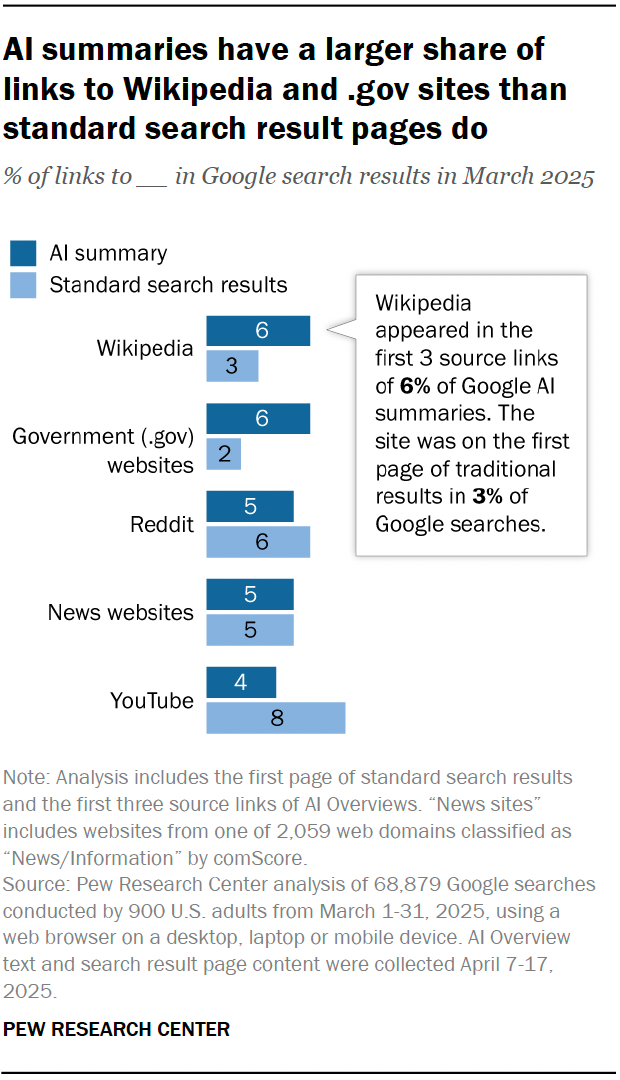 Figure 6: Google's AI summaries lean on a different mix of sites than the normal results. Government sites made up 6% of AI summary links against 2% of standard results, a sign that AI favours sources it treats as authoritative. Source: Pew Research Center, Google users are less likely to click on links when an AI summary appears, Mar 2025 (data). Chart published by the source.
Which sites get cited most?
- Wikipedia, YouTube and Reddit together made up 15% of the sources in Google's AI summaries, and 88% of summaries cited three or more sources (Pew Research Center, AI summaries and clicks, Jul 2025).
- In 1,967,762 citations across 1,355 locations, google.com (Business Profiles) was cited for 94.17% of businesses. Yelp appeared as a source in 80% of ChatGPT's answers, and 415 directories were used in total (BrightLocal, Top sources and directories for local AI search, Aug 2026).
- For plumbers, Google Business Profile was 54% of 26,672 AI citations, Yelp 13.80% and Angi 2.20% (BrightLocal, Top sources and directories for local AI search, Aug 2026).
- Business websites made up 93% of the unique domains AI cited and 42% of all citations (BrightLocal, What 200k local AI searches tell us, Sep 2026).
- Across 3 million+ US queries in September 2026, YouTube had 22.9% of AI Overview citations among the top 50 sites, Reddit 18.5% and Facebook 10.1% (Ahrefs, The 50 Most-Cited Websites in Google AI Overviews, Sep 2026).
Do different AI models cite different things?
- Websites were 44% of brand citations, listings 42%, reviews and social 8% and forums 2%. Gemini leaned on websites (52.1%) and OpenAI on listings (48.7%) (Yext, 86% of AI Citations Come from Brand-Managed Sources, Oct 2025).
- For "best" questions, OpenAI's citations to third-party directories peaked at 46.3%, while Perplexity gave industry-specific directories 24% of its citations (Yext, AI Citations, User Locations and Query Context, Oct 2025).
- In 17.2 million citations, listings were 54.53% of distinct URLs, and Claude cited reviews and social 2-4x more than other models (Yext, AI Citation Behavior Across Models, Apr 2026).
- In the Whitespark study, 60% of AI Overview citations on mixed plumber searches went to third-party publishers (Whitespark, The Prevalence of AI Overviews in Local Search, May 2025).
- Half of the links in ChatGPT 4o responses pointed to business or service websites (Semrush, We Studied the Impact of AI Search on SEO Traffic, Jul 2025).
- Citations appeared in about 6.8% of US ChatGPT prompts by May 2026, up from 1.6% a year earlier, but in under 4% of Professional Services prompts (Similarweb, AI Search Stats 2026, Jul 2026).
Does ranking on Google get you cited?
- 38% of pages cited in AI Overviews also ranked in Google's top 10 for the same query, down from about 76% in Ahrefs' July 2025 study (Ahrefs, 38% of AI Overview Citations Pull From The Top 10, Mar 2026).
- Only 12% of the links cited by ChatGPT, Gemini and Copilot ranked in Google's top 10 for the same prompt (Ahrefs, Only 12% of AI Cited URLs Rank in Google's Top 10, Aug 2025).
- 92% of AI Mode answers showed a sidebar of about 7 domains, and those links had a 51% domain overlap with Google's top 10 (Semrush, Google AI Mode vs. Traditional Search, Jul 2025).
- 47 local search experts ranked presence on expert-curated "best of" lists as the top factor for AI search visibility (Whitespark, Local Search Ranking Factors 2026, Nov 2025).
- In a lab test, adding citations, quotations and statistics to a page raised its visibility in generative engine answers by up to 40% (Aggarwal et al., GEO: Generative Engine Optimization, arXiv 2311.09735, Jun 2024). A review of 45 later studies found no technique with a stable effect across platforms over time (arXiv 2607.14035, A Critical Survey of Generative Engine Optimization, Jul 2026).
How often do AI bots read websites?
- Training makes up nearly 80% of AI bot activity, and in July 2025 Anthropic's crawler made 38,000 crawls per visitor it referred, against 194 for Perplexity (Cloudflare, The crawl-to-click gap, Aug 2025).
- AI bots made 4.2% of HTML requests across Cloudflare in 2025 and Googlebot alone 4.5%, while crawling triggered by user questions to chatbots grew more than 15x (Cloudflare, 2025 Radar Year in Review, Dec 2025).
- Most major AI crawlers do not run JavaScript (Gemini and AppleBot are the exceptions), so a site that only shows its text after scripts load may be invisible to them. This data is from late 2024 (Vercel, The rise of the AI crawler, Dec 2024).
Which local businesses get recommended by AI?
AI recommends far fewer businesses than the map shows, and its picks change from one ask to the next. Fewer slots means each one is worth more.
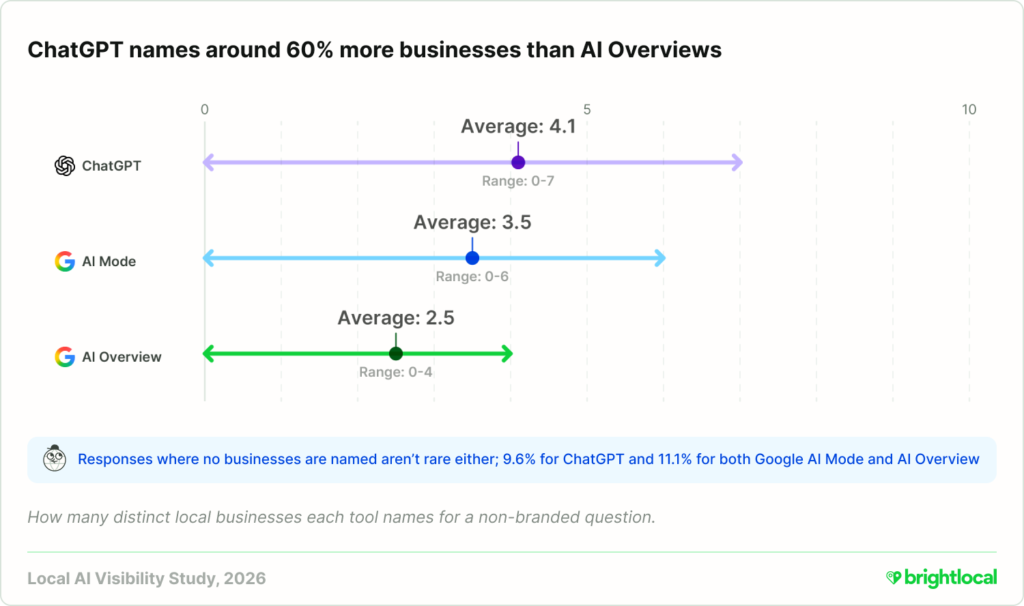 Figure 7: An AI answer is a short list. ChatGPT names 4.1 businesses on average, AI Mode 3.5 and AI Overviews 2.5, against the three in a local pack plus everything below it. Source: BrightLocal, What 200k local AI searches tell us, Sep 2026. Chart published by the source.
What is Google building for local AI search?
- Google Maps' new Ask Maps feature answers questions conversationally using information from over 300 million places and reviews from more than 500 million contributors (Google, How we're reimagining Maps with Gemini, Mar 2026).
- Search can call local businesses for pricing and availability on a searcher's behalf, starting with searches like "pet groomers near me", and businesses control this in their Business Profile settings (Google, New AI features in Google Search: Call a business, Jul 2025).
How many businesses make the AI shortlist?
- ChatGPT-recommended locations averaged 4.3 stars. The study covered 350,000+ locations of 2,751 multi-location brands, not single small businesses (SOCi, 2026 Local Visibility Index, Jan 2026).
- Gemini recommended 11.0% of brand locations and Perplexity 7.4%, so AI platforms are 3 to 30 times more selective than the local 3-pack (SOCi, Local Visibility Benchmarks for Multi-Location Brands, Aug 2026).
- AI local packs showed on about 7% of tracked keywords and featured 5,943 unique businesses, against 18,330 in regular 3-packs, about 32% as many. 88% of 322 markets had fewer businesses in the AI packs (Sterling Sky, Local SEO Updates 2026, Oct 2026).
Do AI recommendations stay the same?
- Repeat searches returned only 20-33% of the same businesses on average across ChatGPT, AI Mode and AI Overviews, in more than 200,000 local AI searches (BrightLocal, What 200k local AI searches tell us, Sep 2026).
- Service-area businesses were mentioned less often than storefronts on every platform: 29.4% against 33.7% on ChatGPT, and 27.4% against 31.9% on AI Mode. ChatGPT's picks spread up to 287km from the searcher, against 64km for AI Mode (BrightLocal, What 200k local AI searches tell us, Sep 2026).
Are AI tools changing how people use Business Profiles?
- In Q2 2026, Business Profile calls fell 11.9% and website clicks 12.5% year over year, while direction requests rose 21.1%, in one vendor's portfolio of US profiles (Search Engine Land, GMBapi data, Aug 2026).
Methodology and Sources
We used only primary sources: Google, Alphabet, OpenAI, Anthropic and Microsoft for their own products, Pew Research Center, the U.S. Census Bureau, Gallup, NBER and arXiv papers, and studies that publish their method. No statistics roundup pages were cited. Every source was opened on 2 November 2026. Company user counts are self-reported and use different measures (monthly versus weekly), so they are never added up. Several studies come from companies that sell SEO or local SEO software (BrightLocal, SOCi, Yext, Whitespark, Semrush, Ahrefs, Similarweb, Local Falcon, seoClarity, DAC); we cite them as the researchers and label surveys as what people say they do. Similarweb's AI traffic shares change every month; the September 2026 figures come from Similarweb's own monthly update post. BrightLocal's directory study gives Yelp's share of citations as 8.53% in its summary and 9.53% in its table, so we left that share out. The SOCi Local Discovery Index page shows no publish date, so the date shown is the month we checked it. Figures 1 and 3 are Rank Local graphics built from the sources named in their captions; every other figure is the source's own published chart, with the date of its data. User counts change every quarter; this page is reviewed monthly.
Sources
- Google, I/O 2026 keynote: https://blog.google/innovation-and-ai/sundar-pichai-io-2026/
- Google, A new era for AI Search (Search I/O 2026): https://blog.google/products-and-platforms/products/search/search-io-2026/
- Google, How we're reimagining Maps with Gemini (Ask Maps): https://blog.google/products-and-platforms/products/maps/ask-maps-immersive-navigation
- Google, New AI features in Google Search: Call a business: https://blog.google/products-and-platforms/products/search/deep-search-business-calling-google-search
- Google, Gemini app one billion monthly users: https://blog.google/innovation-and-ai/products/gemini-app/one-billion-monthly-users/
- Alphabet, Q2 2026 earnings remarks: https://blog.google/company-news/inside-google/message-ceo/alphabet-earnings-q2-2026/
- Alphabet, Q3 2026 earnings remarks: https://blog.google/company-news/inside-google/message-ceo/alphabet-earnings-q3-2026/
- OpenAI, Scaling AI for everyone: https://openai.com/index/scaling-ai-for-everyone/
- OpenAI, From asking to doing: https://openai.com/index/how-the-world-is-putting-chatgpt-to-work/
- OpenAI, How people are using ChatGPT: https://openai.com/index/how-people-are-using-chatgpt/
- OpenAI, DevDay 2026 Recap: https://openai.com/index/devday-2026-recap/
- NBER Working Paper 34255, How People Use ChatGPT: https://www.nber.org/papers/w34255
- NBER Digest, Workplace Adoption of Generative AI: https://www.nber.org/digest/202412/workplace-adoption-generative-ai
- Anthropic, Economic Index report: https://www.anthropic.com/research/economic-index-march-2026-report
- Microsoft AI, The Copilot Usage Report 2025: https://microsoft.ai/news/its-about-time-the-copilot-usage-report-2025
- Pew Research Center, Americans and AI 2026: https://www.pewresearch.org/internet/2026/06/17/americans-and-ai-2026-chatbots-smart-devices-and-views-on-impact/
- Pew Research Center, AI summaries and clicks: https://www.pewresearch.org/short-reads/2025/07/22/google-users-are-less-likely-to-click-on-links-when-an-ai-summary-appears-in-the-results/
- Pew Research Center, What web browsing data tells us about how AI appears online: https://www.pewresearch.org/data-labs/2025/05/23/what-web-browsing-data-tells-us-about-how-ai-appears-online/
- Pew Research Center, Teens, Social Media and AI Chatbots 2025: https://www.pewresearch.org/internet/2025/12/09/teens-social-media-and-ai-chatbots-2025/
- Pew Research Center, How Teens Use and View AI: https://www.pewresearch.org/internet/2026/02/24/how-teens-use-and-view-ai/
- Pew Research Center, About 1 in 5 US workers now use AI in their job: https://www.pewresearch.org/short-reads/2025/10/06/about-1-in-5-us-workers-now-use-ai-in-their-job-up-since-last-year/
- Pew Research Center, Young adults in the US are increasingly wary of AI: https://www.pewresearch.org/short-reads/2026/08/18/young-adults-in-the-us-are-increasingly-wary-of-ai-concerned-it-will-take-jobs/
- Pew Research Center authors, arXiv 2608.04831: https://arxiv.org/html/2608.04831
- U.S. Census Bureau, AI Use at U.S. Businesses: https://www.census.gov/library/stories/2026/05/ai-use-businesses.html
- U.S. Census Bureau, The Microstructure of AI Diffusion (CES-WP-26-25): https://www.census.gov/library/working-papers/2026/adrm/CES-WP-26-25.html
- Gallup, Organizational AI Adoption Jumps Six Points: https://www.gallup.com/workplace/712736/organizational-adoption-jumps-six-points.aspx
- Aggarwal et al., GEO: Generative Engine Optimization (arXiv 2311.09735): https://arxiv.org/abs/2311.09735
- arXiv 2607.14035, A Critical Survey of Generative Engine Optimization: https://arxiv.org/abs/2607.14035
- Similarweb, Gen AI website traffic share update, September 2026: https://x.com/Similarweb/status/2109561054883717264
- Similarweb, AI Search Stats 2026: https://aisearch.similarweb.com/blog/gen-ai-stats/
- Similarweb, Is AI Replacing Search?: https://aisearch.similarweb.com/blog/is-ai-replacing-search
- Similarweb, AI Referral Traffic by Industry: https://aisearch.similarweb.com/blog/ai-referral-traffic-by-industry/
- Similarweb, 2025 Generative AI Landscape press release: https://ir.similarweb.com/news-events/press-releases/detail/138/ai-discovery-surges-similarwebs-2025-generative-ai-report-says
- SparkToro, In 2026, Less than One Third of Google Searches Still Send a Click: https://sparktoro.com/blog/in-2026-less-than-one-third-of-google-searches-still-send-a-click/
- Ahrefs, AI Overviews Reduce Clicks by 58%: https://ahrefs.com/blog/ai-overviews-reduce-clicks-update/
- Ahrefs, AI Overviews Reduce Clicks by 34.5%: https://ahrefs.com/blog/ai-overviews-reduce-clicks/
- Ahrefs, Insights From 55.8M AI Overviews: https://ahrefs.com/blog/insights-from-56-million-ai-overviews/
- Ahrefs, 38% of AI Overview Citations Pull From The Top 10: https://ahrefs.com/blog/ai-overview-citations-top-10
- Ahrefs, Only 12% of AI Cited URLs Rank in Google's Top 10: https://ahrefs.com/blog/ai-search-overlap
- Ahrefs, The 50 Most-Cited Websites in Google AI Overviews: https://ahrefs.com/blog/most-cited-domains-ai-overviews
- Seer Interactive, AIO Impact on Google CTR 2026 Update: https://www.seerinteractive.com/insights/aio-impact-on-google-ctr-2026-update
- Advanced Web Ranking, Google Organic CTR 2026: https://www.advancedwebranking.com/seo/organic-ctr
- Semrush, AI Overviews Study: https://www.semrush.com/blog/semrush-ai-overviews-study/
- Semrush, Google AI Mode vs. Traditional Search: https://www.semrush.com/blog/ai-mode-comparison-study/
- Semrush, We Studied the Impact of AI Search on SEO Traffic: https://www.semrush.com/blog/ai-search-seo-traffic-study/
- seoClarity, Impact of Google's AI Overviews: https://www.seoclarity.net/research/ai-overviews-impact
- Local Falcon, The Impact of Google AI Overviews on Local Business Search Visibility: https://www.localfalcon.com/research/whitepaper-studies-the-impact-of-google-ai-overviews-on-local-business-search-visibility
- DAC, AI Overviews vs. the Maps Pack: https://www.dacgroup.com/wp-content/uploads/2025/08/AI-Overviews-vs.-the-Maps-Pack-Whitepaper-DAC-1.pdf
- Whitespark, The Prevalence of AI Overviews in Local Search: https://whitespark.ca/blog/case-study-the-prevalence-of-ai-overviews-in-local-search/
- Whitespark, Local Search Ranking Factors 2026: https://whitespark.ca/local-search-ranking-factors/
- Sterling Sky, Local SEO Updates 2026: https://www.sterlingsky.ca/the-state-of-local-seo-in-2026/
- BrightLocal, Nearly Half of Consumers are Asking AI: https://www.brightlocal.com/research/lcrs-ai-trust/
- BrightLocal, Local Consumer Review Survey 2026: https://www.brightlocal.com/research/local-consumer-review-survey/
- BrightLocal, Consumer Search Behavior 2026 part 2: https://www.brightlocal.com/research/consumer-search-behavior-channels/
- BrightLocal, Consumer Search Behavior 2025: https://www.brightlocal.com/research/consumer-search-behavior/
- BrightLocal, What 200k local AI searches tell us: https://www.brightlocal.com/research/local-ai-visibility-study/
- BrightLocal, Top sources and directories for local AI search: https://www.brightlocal.com/resources/ai-directory-sources/
- SOCi, 2026 Local Visibility Index: https://www.soci.ai/news/in-ai-driven-discovery-few-brands-are-chosen-most-disappear/
- SOCi, Local Visibility Benchmarks for Multi-Location Brands: https://www.soci.ai/blog/local-visibility-benchmarks/
- SOCi, 2026 Local Discovery Index: https://www.soci.ai/blog/ai-local-search-verification-loop/
- Yext, 86% of AI Citations Come from Brand-Managed Sources: https://www.yext.com/about/news-media/ai-citations-release
- Yext, AI Citations, User Locations and Query Context: https://www.yext.com/research/articles/ai-citations-user-locations-query-context/
- Yext, AI Citation Behavior Across Models: https://www.yext.com/research/articles/ai-citation-behavior-across-models
- Yext, The Rise of AI Search Archetypes: https://www.yext.com/about/news-media/ai-archetypes-study-2025
- Cloudflare, The crawl-to-click gap: https://blog.cloudflare.com/crawlers-click-ai-bots-training/
- Cloudflare, 2025 Radar Year in Review: https://blog.cloudflare.com/radar-2025-year-in-review/
- Vercel, The rise of the AI crawler: https://vercel.com/blog/the-rise-of-the-ai-crawler
- Search Engine Land, GMBapi data: https://searchengineland.com/calls-clicks-falling-google-maps-destination-486276
Glossary
- AI Overview: the AI-written summary Google shows at the top of some search results.
- AI Mode: Google's separate AI search experience.
- Ask Maps: the conversational AI feature inside Google Maps.
- Click-through rate (CTR): the share of people who see a result and click it.
- Citation (in AI answers): a website or listing the AI tool links to or names as its source.
- Local pack (map pack, 3-pack): the box of businesses with a map that Google shows for local searches.
- Monthly vs weekly active users: people who used a product at least once in a month, or in a week. The two can't be compared.
- Zero-click search: a search that ends without the person clicking any result.
- GEO (generative engine optimization): work aimed at getting a site cited in AI answers.