103 Local Search Statistics for 2026
Updated November 2026
More than half of people looking for a local business still start on Google. That part has not changed. What has changed is everything after the first tap: how many places people check, how fast they decide, how hard they look at reviews, and how often the search ends without a single click.
Every number on this page comes from the group that produced it: Google, Pew Research Center, the FTC, the U.S. Census Bureau, a platform's own report, or a study that publishes how it was done. Each one is linked and dated. Where two studies disagree, we show both and say why, instead of picking the one that sounds better.
This is the main page of our local data section. For the deeper cuts, see Google Business Profile statistics and AI search and local business statistics.
Key Takeaways
- 84% of consumers searched online for a local business in the last three months (BrightLocal, Consumer Search Behavior 2026 part 1, Jun 2026).
- 75% used more than one channel in their most recent local business search (BrightLocal, Consumer Search Behavior 2026 part 2, Jul 2026).
- 91% of US adults own a smartphone, and 16% are smartphone-only internet users (Pew Research Center, Mobile Fact Sheet, Oct 2026).
- Google Maps passed 2 billion monthly users (Alphabet, Q3 2024 earnings remarks, Oct 2024).
- 47% of consumers won't use a business with fewer than 20 reviews (BrightLocal, Local Consumer Review Survey 2026, Feb 2026).
- Google blocked or removed over 292 million policy-violating reviews and over 13 million fake Business Profiles in 2025 (Google, New ways we're protecting businesses on Maps, Apr 2026).
- The FTC can seek civil penalties of up to $53,088 per fake-review violation (FTC, warning letters to 10 companies, Dec 2025).
- Yelp filtered nearly 500,000 suspected AI-generated reviews in 2025 (Yelp Trust & Safety Report 2025, Feb 2026).
- 56% of consumers have been unable to find a suitable local business because businesses were too far away, had too few reviews, or didn't seem right (BrightLocal, Consumer Search Behavior 2026 part 3, Jul 2026).
- Google users clicked a traditional result on 8% of visits with an AI summary, against 15% without one (Pew Research Center, AI summaries and clicks, Jul 2025).
- The share of consumers using AI tools for local recommendations climbed from 6% to 45% in a year (BrightLocal, Local Consumer Review Survey 2026, Feb 2026).
- The US has 36,207,130 small businesses (U.S. SBA Office of Advocacy, Small Business FAQ 2026, Feb 2026).
Where do people start a local search?
Google still owns the start of the local search. It just doesn't own the whole trip anymore. Most people begin on Google Search, then check somewhere else before they pick up the phone.
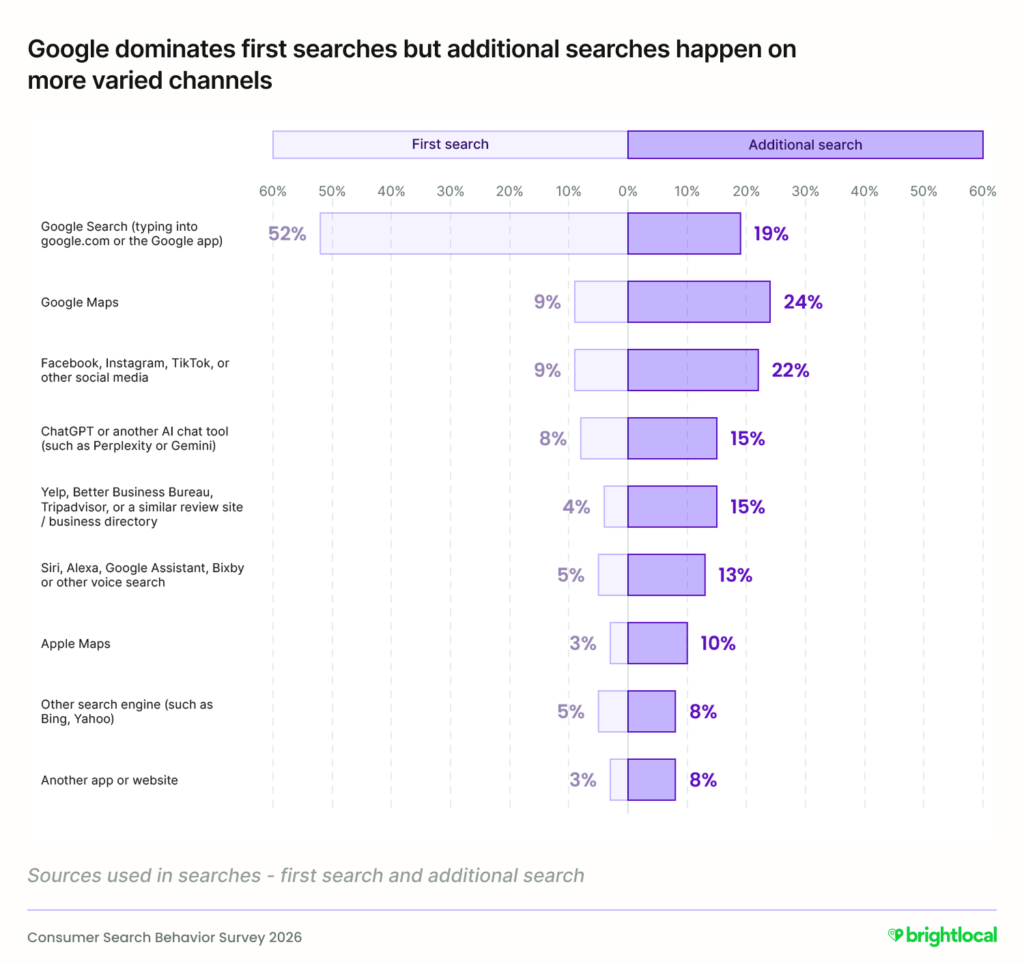 Figure 1: Google is where most local searches begin, but social media, AI tools and review sites all pick up part of the journey after that first search. Source: BrightLocal, Consumer Search Behavior 2026 part 2, Jul 2026. Chart published by the source.
Which app or site do people open first?
- Back in 2014, Google's own study found 4 in 5 consumers use search engines for local information (Google with Ipsos MediaCT and Purchased, Understanding Consumers' Local Search Behavior, May 2014).
- In 2026, 52% of consumers started their most recent local business search on Google Search, and a further 9% started on Google Maps (BrightLocal, Consumer Search Behavior 2026 part 2, Jul 2026).
- 1 in 5 consumers conduct local searches directly within maps (BrightLocal, Consumer Search Behavior 2025, Apr 2025).
Where else do they look before deciding?
- 71% used Google Search at some point in their latest search. Social media was used by 30%, AI tools by 23% and review sites by 19% (BrightLocal, Consumer Search Behavior 2026 part 2, Jul 2026).
- 58% of consumers search online several times a day (BrightLocal, Consumer Search Behavior 2025, Apr 2025).
- In SOCi's survey of more than 1,000 US consumers, use of social media to discover local businesses rose from 17% in 2024 to 55% in 2026, and 43% use social media to preview a place before visiting (SOCi, AI Local Search and the Verification Loop, Sep 2026).
Which social platforms do US adults use?
- 84% of US adults say they ever use YouTube and 71% use Facebook. TikTok is used by 37% and WhatsApp by 32% (Pew Research Center, Americans' Social Media Use 2025, Nov 2025).
- 37% of US adults visit Facebook several times a day and 33% say the same of YouTube. 24% are daily TikTok users (Pew Research Center, Americans' Social Media Use 2025, Nov 2025).
How big is local search for businesses?
- Local results in Search drive more than 4 billion connections for businesses every month, including more than 2 billion website visits, plus calls, directions and reservations. Google also connects people with more than 120 million businesses that don't have a website each month (Google, How 15 years of mapping the world makes Search better, Dec 2020).
- Google Maps has information for more than 250 million places and over 300 million contributors a year (Google, How Google Maps protects against fake content, Nov 2023).
- Google says Maps provided 1 trillion kilometers of directions in 2024 and gets 100 million updates to the map each day (Google, 20 things you didn't know you could do with Google Maps, Feb 2025).
How many local businesses are competing for those searches?
Most local businesses are tiny, and there are more of them every year. That is the field every service business is ranking against, and most of it has no marketing team.
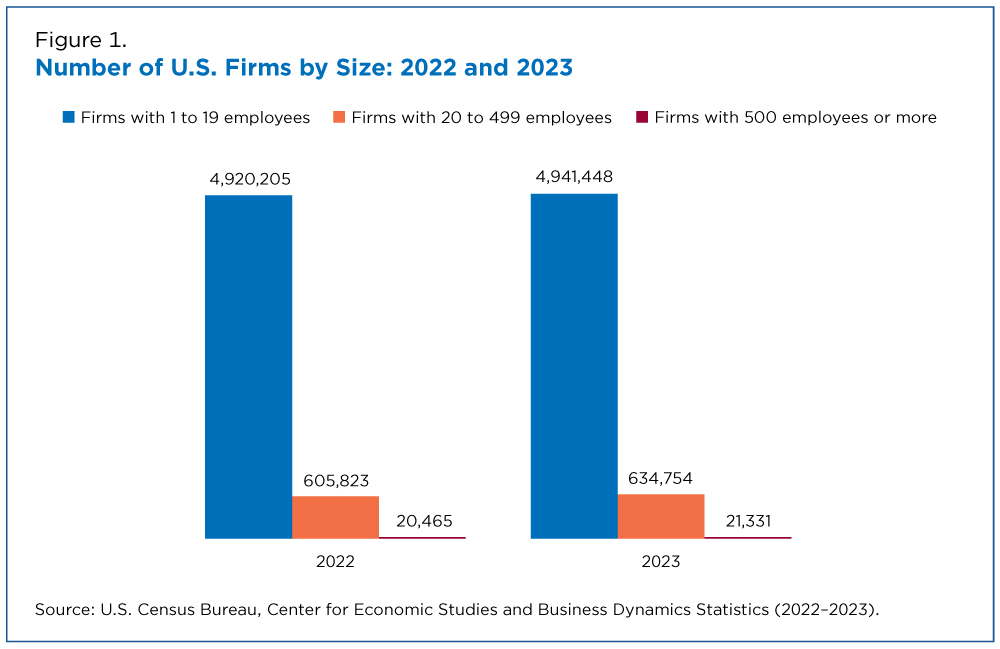 Figure 2: Almost all US employer firms have fewer than 20 employees, so the business down the road is usually as small as yours. Source: U.S. Census Bureau, Census Bureau Provides Resources, Data Tools, Website for Small Businesses, May 2026 (Business Dynamics Statistics data for 2022 and 2023). Chart published by the source.
How many small businesses are there?
- 99.9% of US businesses are small. They employ 62.3 million people, 45.9% of private sector workers (U.S. SBA Office of Advocacy, Small Business FAQ 2026, Feb 2026).
- There were 5.58 million US firms with at least one employee but fewer than 500 in 2023, up from 5.53 million in 2022 (U.S. Census Bureau, Census Bureau Provides Resources, Data Tools, Website for Small Businesses, May 2026).
- Businesses with no paid employees made up 78.4% of all US establishments in 2023. There were 30,427,808 of them, with nearly $1.8 trillion in revenue (U.S. Census Bureau, Census Bureau Provides Resources, Data Tools, Website for Small Businesses, May 2026).
Is the field getting more crowded?
- From 2012 to 2023, the number of nonemployer businesses grew an average 2.7% a year, against 1.1% for employer businesses (U.S. Census Bureau, Number of U.S. Nonemployers Grew Faster Than Employer Businesses, Jul 2025).
- Business applications for September 2026 were 534,947, seasonally adjusted, up 0.5% on August (U.S. Census Bureau, Business Formation Statistics, Oct 2026).
How many of those businesses use AI themselves?
- As of May 3, 2026, 19.8% of US businesses said they used AI, and less than 20% of firms with four or fewer employees did (U.S. Census Bureau, AI Use at U.S. Businesses, May 2026).
- Among firms that use AI, Sales and Marketing is the most common business function for it, at 52% (U.S. Census Bureau, The Microstructure of AI Diffusion, Apr 2026).
What shows up on a local search: the map pack or an AI answer?
On a true "I need someone now" search, the map pack still wins the screen. Ask a how-to question and the picture flips. How often AI answers show up depends almost entirely on how a study defines a "local" search, so read each number with its method.
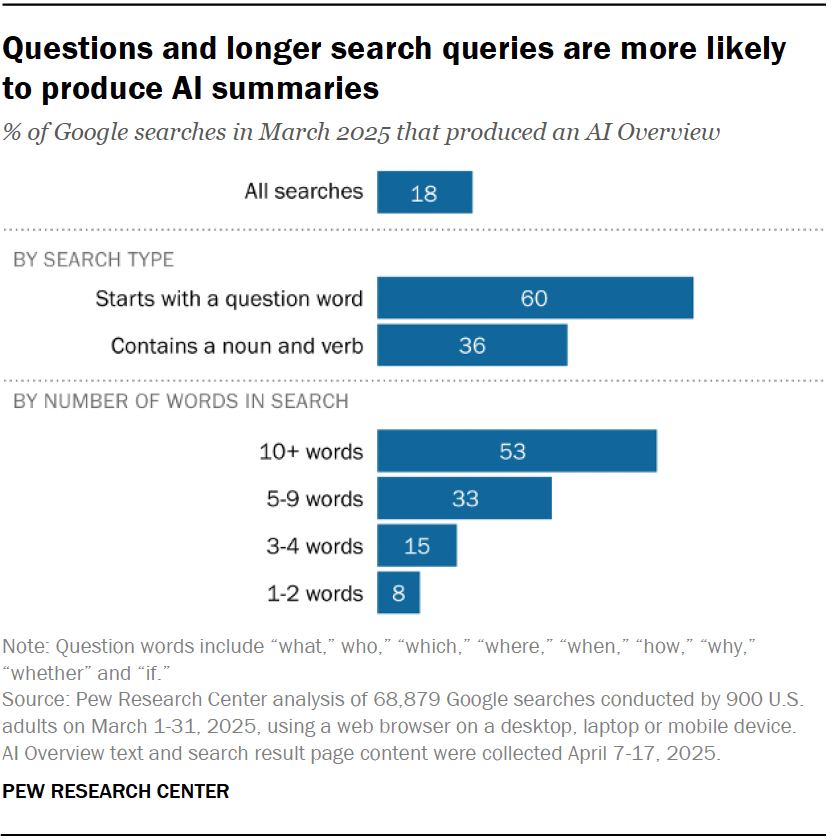 Figure 3: Long, question-style searches are the ones that pull in an AI summary. Short "service plus town" searches mostly don't. Source: Pew Research Center, AI summaries and clicks, Jul 2025 (data from March 2025). Chart published by the source.
How many people see Google's AI answers?
- AI Overviews now has over 2.5 billion monthly active users (Google, I/O 2026 keynote remarks, May 2026).
- Since expanding AI Mode globally, Google says it has surpassed 1 billion monthly active users (Alphabet, Q2 2026 earnings remarks, Jul 2026).
- Across 10M+ keywords, AI Overviews were triggered for 6.49% of queries in January 2025, 24.61% in July and 15.69% in November (Semrush, AI Overviews Study, Dec 2025).
How often does the map pack show compared with an AI Overview?
- In a hand-checked study of 540 searches across 3 cities and 6 service industries, local packs appeared on 93% of local-intent searches and AI Overviews on 15%. For informational searches AI Overviews appeared 92% of the time, and 97% for mixed searches. Across all 540, AI Overviews showed on 68% and local packs on 39% (Whitespark, The Prevalence of AI Overviews in Local Search, May 2025).
- Searches containing "near me" showed an AI Overview 0% of the time and a map pack 100% of the time. An AI Overview and a map pack appeared together on about 1% of 739 results pages. For home services, the AI Overview rate was 27% and the map pack rate 29% (DAC Group, AI Overviews vs. the Maps Pack, Aug 2025).
- AI-powered local packs showed on about 7% of the keywords Sterling Sky tracks, so far only on mobile and only in the US. Across 322 markets they featured 5,943 unique businesses against 18,330 in regular 3-packs, about 32% as many (Sterling Sky, Local SEO Updates 2026, Oct 2026).
- Local pack ads showed on 1% of Sterling Sky's mobile ranking reports at the start of 2025 and almost 22% by December 2025. Local Services Ads went from roughly 11% of tracked queries to 31% in November (Sterling Sky, Local SEO Updates 2026, Oct 2026).
Why do the studies disagree so much?
- A study of 60,000 local-business searches for 4,423 businesses in 20 countries found AI Overviews on 40.2% of them, with cleaning services at 65.0% and legal services at 62.1% (Local Falcon, The Impact of Google AI Overviews on Local Business Search Visibility, May 2025).
- In the same study, queries without a location name were 11.1 percentage points more likely to trigger an AI Overview than queries that named a place (Local Falcon, The Impact of Google AI Overviews on Local Business Search Visibility, May 2025).
- Measured across a database of 500+ million US keywords, AI Overviews appeared for 0.14% of local keywords in March 2025, falling to 0.01% in September 2025 (seoClarity, Impact of Google's AI Overviews, Sep 2025).
- In Google's AI Mode, 13.49% of queries included a local pack, in a test of 5,000 keywords (Semrush, AI Mode comparison study, Jul 2025).
- Across 2,751 multi-location brands and roughly 350,000 locations, brands appeared in Google's local 3-Pack 35.9% of the time. ChatGPT recommended 1.2% of locations, Gemini 11.0% and Perplexity 7.4% (SOCi, Local Visibility Benchmarks for Multi-Location Brands, Aug 2026).
The spread, from 0.01% to 68%, is about what was counted: hand-typed service searches, a keyword database label, or "near me" phrases. None of them is "the" number. Our AI search hub goes deeper.
How much local searching happens on a phone?
Local search is a phone habit, even though the web as a whole is not. If a business's listing and site only look right on a desktop, most local searchers never see the good version.
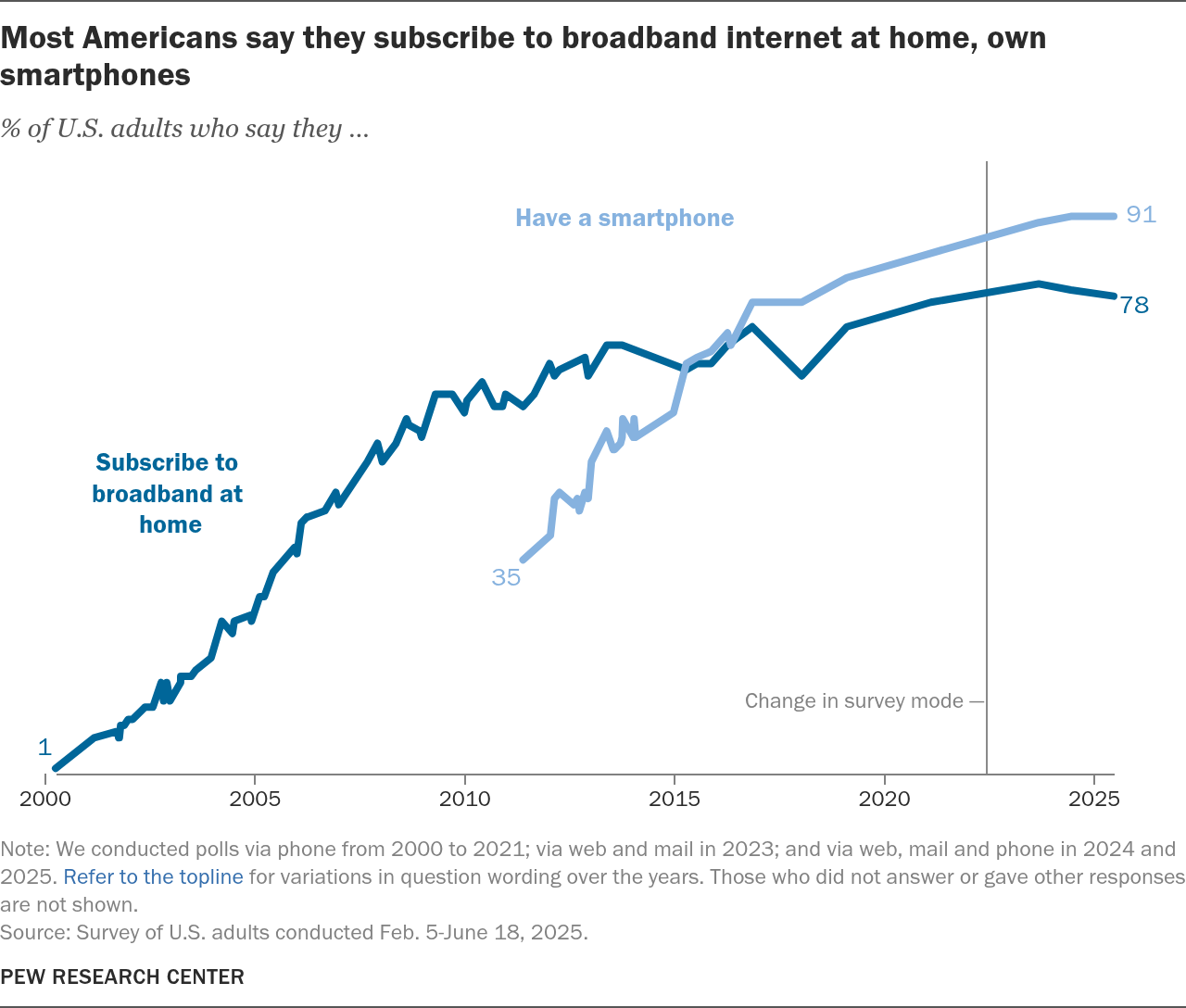 Figure 4: Smartphone ownership passed home broadband years ago, which is why the phone is where most local searches now begin. Source: Pew Research Center, Internet use, smartphone ownership, digital divides in the US, Jan 2026 (survey of US adults, Feb to June 2025). Chart published by the source.
How connected are US adults and households?
- 97% of US adults say they use the internet, and 78% subscribe to home broadband (Pew Research Center, Internet and Broadband Fact Sheet, Oct 2026).
- 41% of US adults say they are online almost constantly, including 63% of adults ages 18 to 29 (Pew Research Center, Internet use, smartphone ownership, digital divides in the US, Jan 2026).
- 97% of adults under 50 have a smartphone, and 78% of those 65 and older still do (Pew Research Center, Internet use, smartphone ownership, digital divides in the US, Jan 2026).
- 95.5% of US households have a computer and 91.0% have a broadband internet subscription, in the Census Bureau's 2020-2024 American Community Survey estimates (U.S. Census Bureau, QuickFacts: United States, Nov 2026).
How many local searches start on a phone?
- For 73% of consumers, their latest local business search started on a phone. Just 19% used a computer and 8% a tablet (BrightLocal, Consumer Search Behavior 2026 part 2, Jul 2026).
- Even among people over 60, 57% started on a phone and 33% on a computer (BrightLocal, Consumer Search Behavior 2026 part 2, Jul 2026).
Is all web browsing mobile now?
- No. In October 2026, desktop carried 52.4% of US web traffic, mobile 45.43% and tablets 2.17%. This counts all page views, not local searches, which is why it reads so differently from the survey above (StatCounter, Desktop vs Mobile vs Tablet Market Share, United States, Oct 2026).
- 98% of US adults own a cellphone of some kind (Pew Research Center, Mobile Fact Sheet, Oct 2026).
How fast do people pick a local business?
The shortlist is short and the clock is fast. A business that isn't in the first few results, or looks inactive when someone checks, rarely gets a second look.
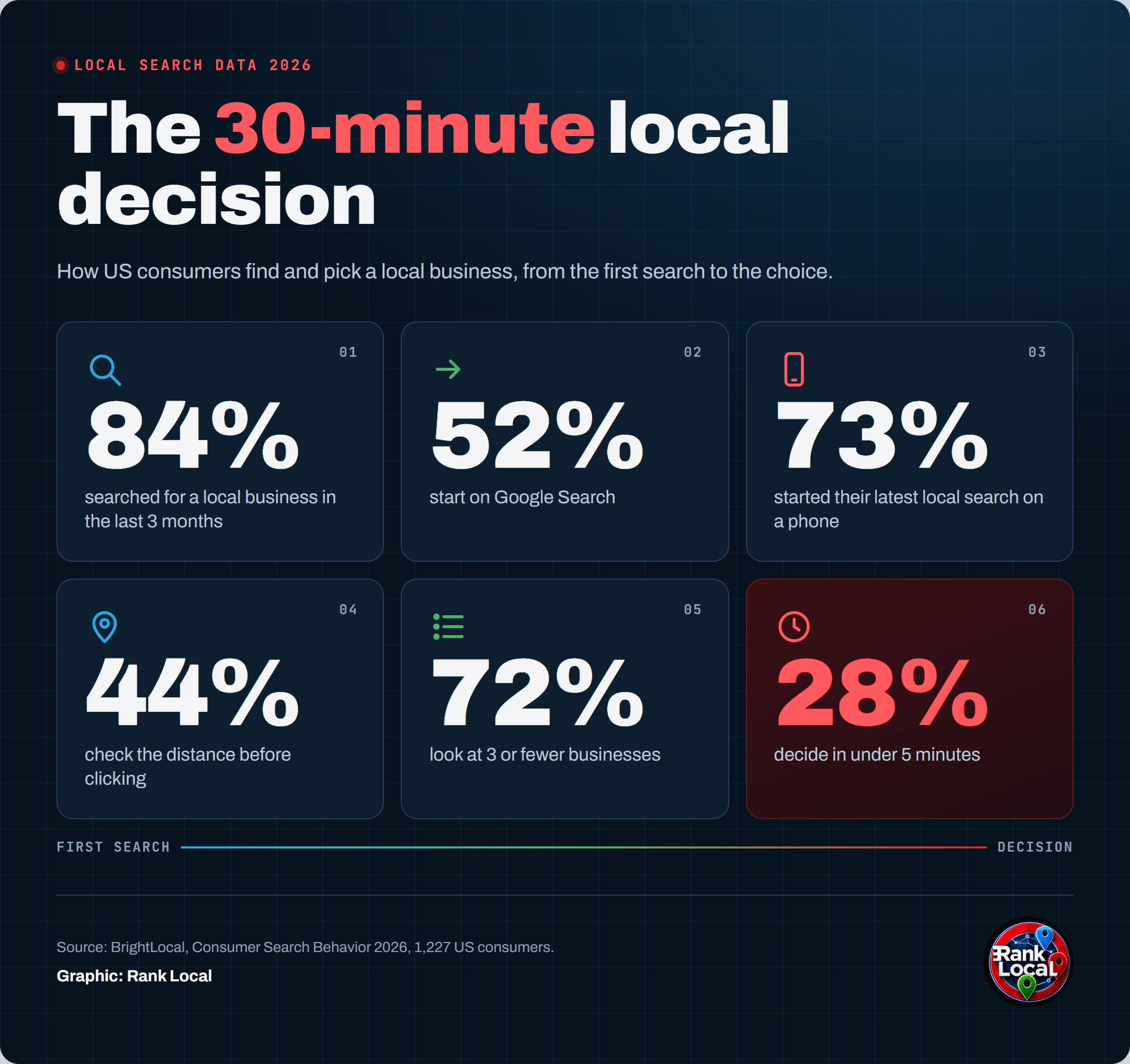 Figure 5: The 30-minute local decision, from the first search to the choice: most people search on a phone, start on Google, check how close the business is and pick from a handful of options. Source: BrightLocal, Consumer Search Behavior 2026 part 1, Jun 2026; BrightLocal, Consumer Search Behavior 2026 part 2, Jul 2026; BrightLocal, Consumer Search Behavior 2026 part 3, Jul 2026. Graphic by Rank Local from those sources.
How many businesses do people compare?
- In BrightLocal's panel of 1,227 US consumers, 72% look at three or fewer businesses before making a decision, and only 1% look at more than ten (BrightLocal, Consumer Search Behavior 2026 part 1, Jun 2026).
- For 28% of people, the decision is made in under five minutes (BrightLocal, Consumer Search Behavior 2026 part 1, Jun 2026).
- 75% of consumers take less than 30 minutes to decide which business to use. Even for professional services, just 10% spend more than an hour researching before they choose (BrightLocal, Consumer Search Behavior 2026 part 1, Jun 2026).
- In Google's 2014 diary study, 18% of local smartphone searches led to a purchase within a day, against 7% of non-local searches (Google with Ipsos MediaCT and Purchased, Understanding Consumers' Local Search Behavior, May 2014).
Why do people pass on a business they found?
- 52% looked at a business in their latest search and decided not to contact them (BrightLocal, Consumer Search Behavior 2026 part 3, Jul 2026).
- Of those who were put off, 65% gave a review-related reason and 62% gave a reason tied to the business looking inactive (BrightLocal, Consumer Search Behavior 2026 part 3, Jul 2026).
- 85% say contact information and opening hours are important when researching local businesses (BrightLocal, Consumer Search Behavior 2025, Apr 2025).
- 63% of consumers have walked away from a business that couldn't answer a question they needed answered (SOCi, AI Local Search and the Verification Loop, Sep 2026).
How much do reviews matter for a local business?
Customers raised the bar, and the platforms and regulators started enforcing it at the same time. A thin or stale review profile now costs a business customers, and a faked one can cost it far more.
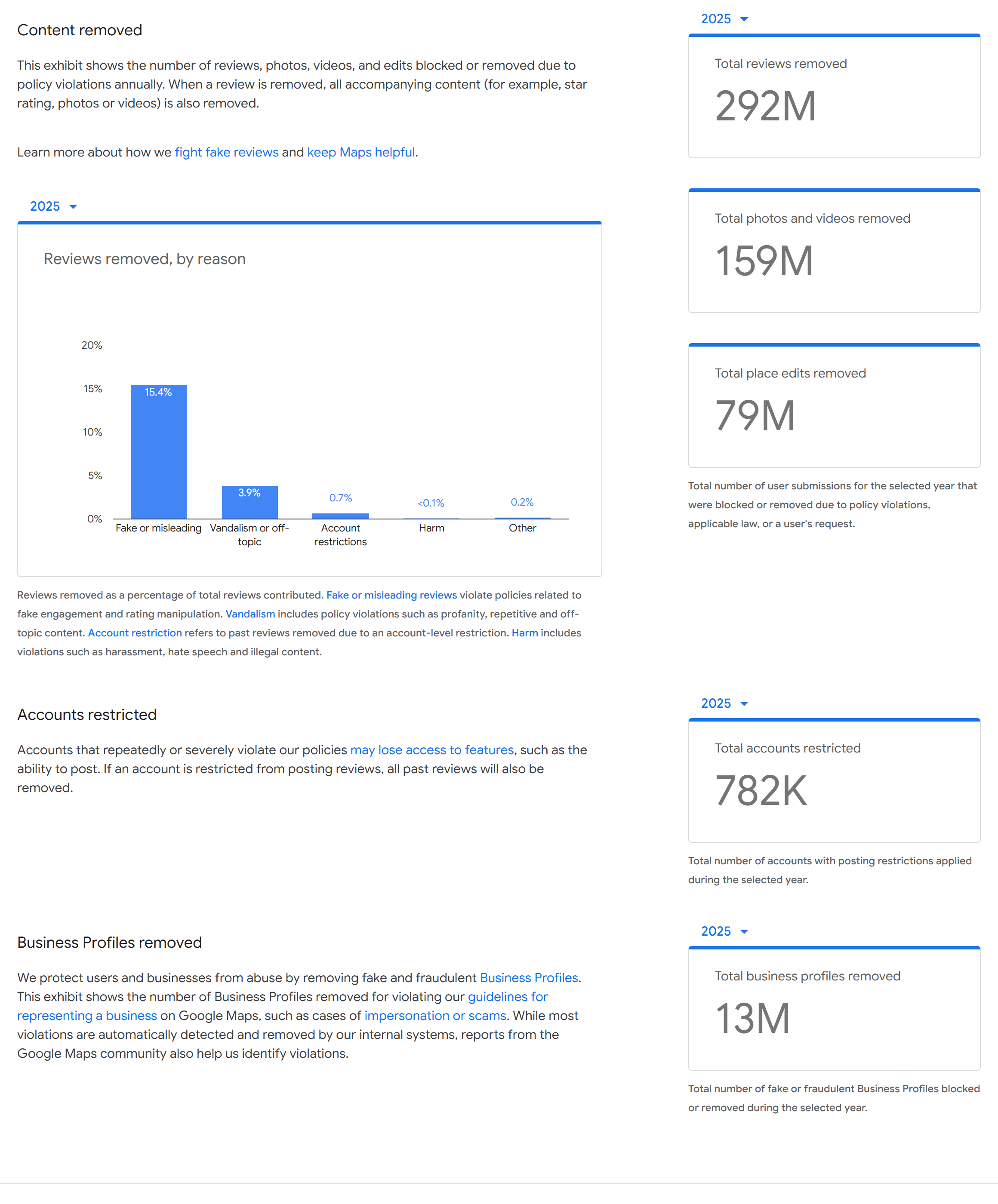 Figure 6: Google's own enforcement numbers for 2025. Reviews removed as fake or misleading are measured against every review contributed, which shows how much of the review stream gets filtered. Source: Google Maps Content Trust & Safety Report, Nov 2026 (2025 data). Screenshot of the source page, captured 2 Nov 2026.
How many reviews are people writing?
- Google's community shared over 1 billion reviews and suggested 80 million updates to business hours, contact information and more in 2025 alone (Google, New ways we're protecting businesses on Maps, Apr 2026).
- Yelp received about 22 million reviews in 2025: 70% were recommended, 17% not recommended, 11% removed by Yelp and 2% removed by the people who wrote them (Yelp Trust & Safety Report 2025, Feb 2026).
- Across 8,952 businesses in six verticals, all verticals received fewer first-party reviews in 2025 than in 2024. Healthcare businesses averaged 85, down from 187 (GatherUp, 2025 Reputation Benchmarks, Feb 2026).
What do customers expect from reviews now?
- In 2026, 31% of consumers will only use a business with 4.5 stars or more, up from 17% the year before (BrightLocal, Local Consumer Review Survey 2026, Feb 2026).
- 97% of consumers read reviews for local businesses, and 41% "always" read them, up from 29% the year before (BrightLocal, Local Consumer Review Survey 2026, Feb 2026).
- 74% look for reviews from the last three months (BrightLocal, Local Consumer Review Survey 2026, Feb 2026).
- In SOCi's survey, 99% of consumers read reviews before a first visit at least some of the time, and 68% do so always or most of the time (SOCi, AI Local Search and the Verification Loop, Sep 2026).
What do reviews make people do?
- 85% are more likely to use a business after reading positive reviews, and 77% are put off by negative ones. 54% visit the business's website after reading positive reviews, up from 32% in 2019 (BrightLocal, Local Consumer Review Survey 2026, Feb 2026).
- Google's share as a review source dipped from 83% to 71% in a year, while Apple Maps rose from 14% to 27%. 11% of consumers were offered an incentive to leave a positive review (BrightLocal, Local Consumer Review Survey 2026, Feb 2026).
- The UK competition regulator estimates as much as £23 billion of UK consumer spending a year is potentially influenced by online reviews (UK CMA, CMA secures important changes from Google to tackle fake reviews, Jan 2025).
How much are platforms removing?
- Google says it blocked or removed more than 240 million policy-violating reviews from 2024, along with more than 70 million policy-violating edits, and put posting restrictions on more than 900,000 accounts (Google, New ways AI helps keep business information trustworthy, Apr 2025).
- In 2025, Google removed 15.4% of all contributed reviews as fake or misleading and 3.9% as vandalism or off-topic. It also removed 159M photos and videos and restricted 782K accounts (Google Maps Content Trust & Safety Report, Nov 2026).
- In 2023 Google saw around 20 million contributions per day on Maps and Search, and its new algorithm took down 45% more fake reviews than the year before (Google, How machine learning keeps contributed content helpful, Feb 2024).
- Yelp rejected more than 50,700 potential new business pages in 2025, with extra checks on locksmiths, garage door repair, roadside assistance and plumbing (Yelp Trust & Safety Report 2025, Feb 2026).
- Yelp placed 491 Compensated and Suspicious Review Activity Alerts on business pages in 2025, and closed over 1,900 accounts in the US and Canada tied to review exchange rings (Yelp Trust & Safety Report 2025, Feb 2026).
What does the law say about fake reviews?
- The FTC's final rule bans fake reviews, including AI-generated ones, buying positive or negative reviews, and undisclosed insider reviews. The Commission voted 5-0 (FTC, Final Rule Banning Fake Reviews and Testimonials, Aug 2024).
- In December 2025 the FTC sent warning letters to 10 companies about possible violations of that rule (FTC, warning letters to 10 companies, Dec 2025).
- In May 2026 the FTC and Illinois sued a company accused of creating thousands of fake business profiles for home repair companies that did not exist, and of posting fabricated five-star reviews to dilute real one-star ones. The Commission vote to refer the case was 2-0 (FTC, FTC and Illinois Take Action Against Fake Local Home Repair Listings, May 2026).
More enforcement numbers, year by year, are on our Google Business Profile statistics page.
What makes someone pick one business over another?
Distance decides more than most businesses want to admit. People check where a business is before they click, and Google weighs it before it shows them anything.
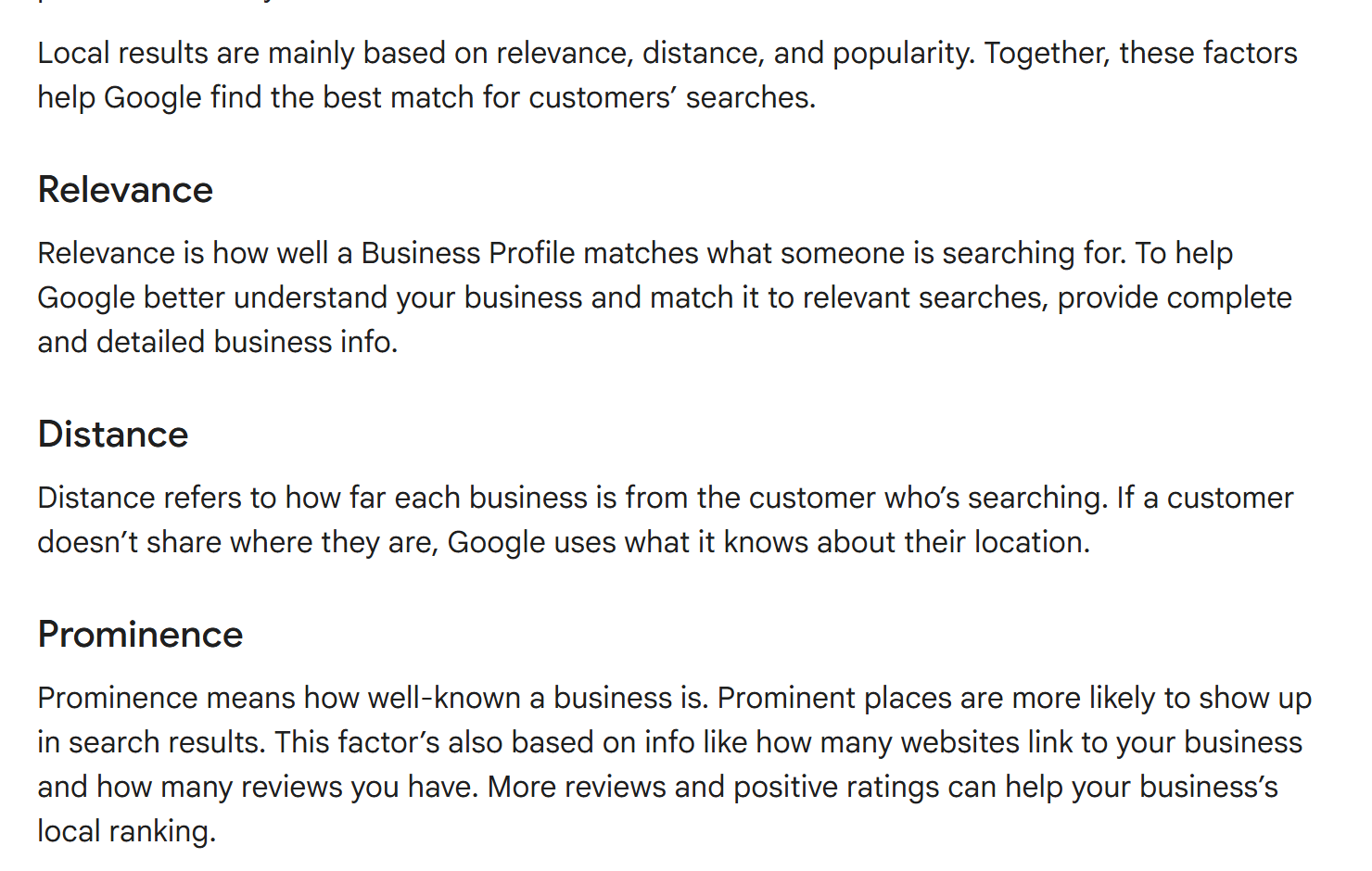 Figure 7: Google's own explanation of local ranking. Distance is one of three named factors, and the page gives no weights for any of them. Source: Google Business Profile Help, Tips to improve your local ranking, Nov 2026 (undated help page, checked that month). Screenshot of the source page, captured 2 Nov 2026.
What does Google say decides local results?
- Google's own help page says: "Local results are mainly based on relevance, distance, and popularity." It gives no weights (Google Business Profile Help, Tips to improve your local ranking, Nov 2026).
- A service-area business can set up to 20 service areas on its Business Profile, by city, postal code or other area (Google Business Profile Help, Manage your service areas, Nov 2026).
- In a survey of 47 local search experts scoring 187 factors, "proximity of address to the point of search" ranked #2 for the local pack (score 225), just behind the primary Business Profile category (227). This is expert opinion, not measured data (Whitespark, Local Search Ranking Factors 2026, Nov 2025).
- In the same survey, quantity of native Google reviews scored 170 and recency of reviews 164 for the local pack (Whitespark, Local Search Ranking Factors 2026, Nov 2025).
Do people check how close a business is?
- Proximity is the most important factor for consumers in the research stage: 44% look at the address or how close the business is before clicking on it (BrightLocal, Consumer Search Behavior 2026 part 3, Jul 2026).
Does distance matter inside AI answers?
- Inside AI Overviews, Local Falcon found effectively no link between distance and ranking position (correlation coefficient 0.001). Businesses appeared 72.0% of the time from grid points within 1 mile and 68.5% from points 1-2 miles away (Local Falcon, The Impact of Google AI Overviews on Local Business Search Visibility, May 2025).
Does hiding the address or review count matter?
- A study of 8,186 businesses in 200 US cities, on 5 home-service "near me" searches, found that hiding the address (a service-area listing) correlated negatively with "near me" map pack rankings, and that the number of reviews a business got each month mattered more than its total (Sterling Sky with Places Scout, What gets you ranking for "near me", Nov 2025).
- In Sterling Sky's 2025 test, businesses going from 9 to 10 Google reviews saw a small Maps ranking gain for their main keyword. Businesses going from 10 to 11 did not (Sterling Sky, Does the Number of Google Reviews Impact Ranking?, Apr 2025).
How many local searches end without a click?
Ranking is no longer the same as getting the click. More searches end on the results page, and AI answers are part of why.
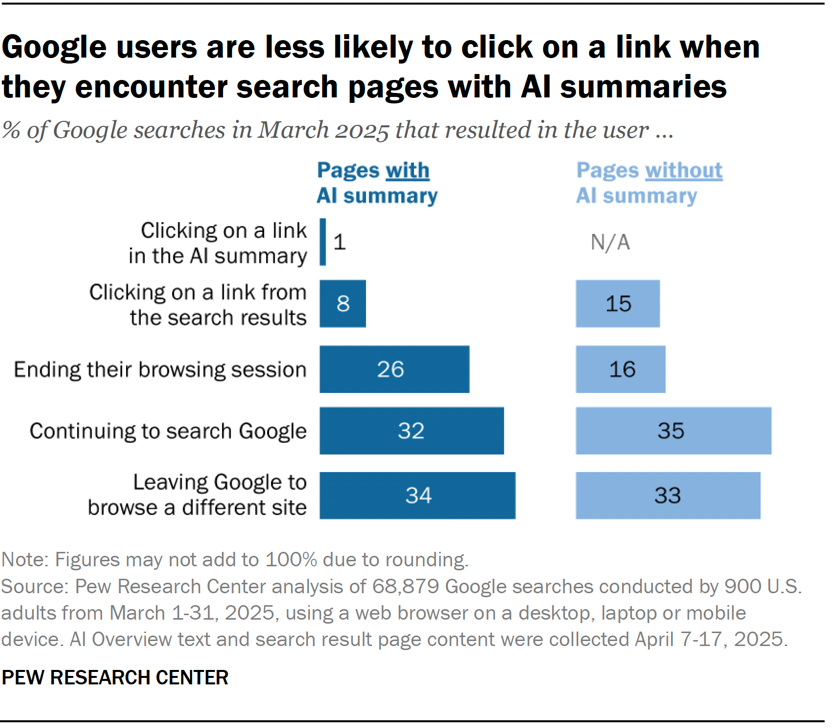 Figure 8: When an AI summary shows, fewer people click a result and more simply stop browsing. This is real browsing data from 900 US adults, not a survey. Source: Pew Research Center, AI summaries and clicks, Jul 2025 (data from March 2025). Chart published by the source.
What happens when an AI summary shows?
- In Pew's study of 68,879 real searches by 900 adults, people clicked a link inside the AI summary on just 1% of visits to pages that had one (Pew Research Center, AI summaries and clicks, Jul 2025).
- 58% of Pew's panel ran at least one search that produced an AI summary in March 2025 (Pew Research Center, What web browsing data tells us about how AI appears online, May 2025).
- Across 300,000 keywords, an AI Overview correlated with a 58% lower average click-through rate for the top-ranking page. This was desktop data on informational keywords, not local searches (Ahrefs, AI Overviews Reduce Clicks by 58%, Feb 2026).
- 74.3% of results pages with an AI Overview ended without an organic click, against 53.6% of pages without one (Advanced Web Ranking, Google Organic CTR by Position: 2026 Study, Sep 2026).
- Across 53 brands and 5.47M tracked queries, organic CTR on queries with an AI Overview climbed from 1.3% in December 2025 to 2.4% in February 2026 (Seer Interactive, AIO Impact on Google CTR: 2026 Update, Apr 2026).
How many Google searches send no click at all?
- In the first four months of 2026, 68.01% of US Google searches ended without a click, against 60.45% in 2024 (SparkToro, Less than One Third of Google Searches Still Send a Click, Jun 2026).
- SparkToro's earlier study, on a different data panel, put zero-click searches at 58.5% in the US and 59.7% in the EU. Because the panels differ, the two studies are not one clean trend line (SparkToro, 2024 Zero-Click Search Study, Jul 2024).
- On Google US desktop in July 2026, a local pack alone cut the #1 organic result's click-through rate by 94%, to 1.17% (Advanced Web Ranking, Google Organic CTR by Position: 2026 Study, Sep 2026).
Are local calls and clicks changing too?
- Across 179 Google Business Profiles for 34 US law firms, clicks-to-call declined over the last 2 years while website clicks did not (Sterling Sky, Local SEO Updates 2026, Oct 2026).
- In GMBapi's Business Profile data, US website clicks and calls each fell 15.8% in Q1 2026 against Q1 2025, while direction requests rose 31.3% (Search Engine Land, Calls and clicks keep falling as Google Maps becomes the destination, Aug 2026).
- AI Mode queries are on average three times longer than traditional searches, and one in five AI Mode searches use voice, images or documents (Alphabet, Q3 2026 earnings remarks, Oct 2026).
How steady are AI recommendations for local businesses?
- In more than 200,000 local AI searches across 1,300+ locations, repeat searches returned only 20-33% of the same businesses on average (ChatGPT 23%, AI Mode 21%, AI Overview 33%), and AI Mode and AI Overviews shared only 29% of businesses (BrightLocal, What 200k local AI searches tell us, Sep 2026).
- About half of US adults (49%) now use AI chatbots, up from a third (33%) in 2024 (Pew Research Center, Americans and AI 2026, Jun 2026).
- When an AI tool recommends a local business, 81% of consumers take a verification step before contacting it. Only 19% go straight from the AI answer to the business (SOCi, AI Local Search and the Verification Loop, Sep 2026).
- In a survey of people who already use voice or conversational AI, 68% had used ChatGPT to research local products or services, but only 19% trusted AI tools for local search against 45% for traditional search engines (Yext, AI Search Archetypes study, Jul 2025).
- In 6.8 million citations from 1.6 million AI responses, local websites made up 8% to nearly 20% of citations. The sample was Yext's own clients and prospects (Yext, AI Citations, User Locations and Query Context, Oct 2025).
- By July 2025, ChatGPT had been adopted by around 10% of the world's adult population (NBER, How People Use ChatGPT, Sep 2025).
Which popular local search statistics don't hold up?
Some of the most repeated local search numbers have no source behind them, or have drifted far from what the source said. We traced them back.
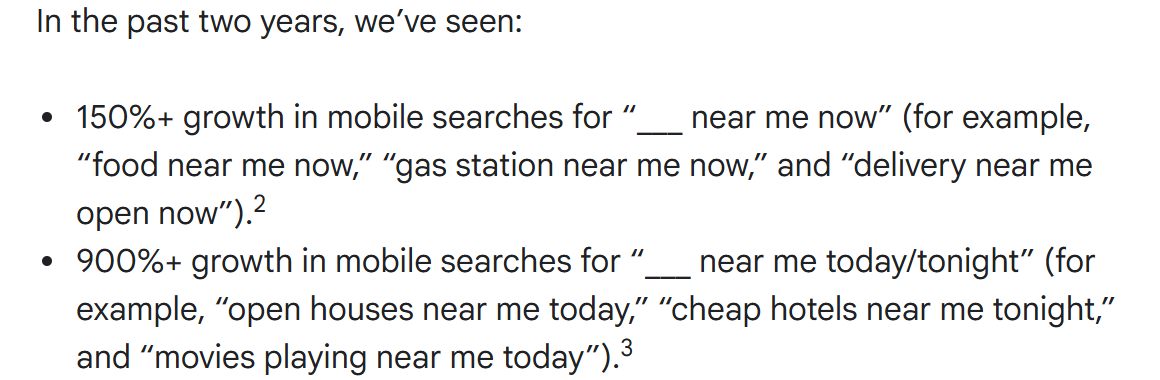 Figure 9: The real "near me" growth figures, as Google published them. Each one is about a specific phrase pattern on mobile over two years, not "near me" searches overall. Source: Think with Google, How 'Near Me' helps us find what we need, May 2018 (Google data, US, July to December 2015 vs. July to December 2017). Screenshot of the source page, captured 2 Nov 2026.
Are 46% of Google searches local?
- We could not find this number in any Google document. Every copy we traced leads back to an infographic agency, not to Google. It is not used on this page.
Did "near me" searches really grow 900%?
- Not as usually quoted. Google's real figure is 900%+ growth in mobile searches for "near me today" and "near me tonight" style phrases, and 150%+ for "near me now", comparing July to December 2015 with July to December 2017 in the US. It is about one kind of phrase over two years, not "near me" searches overall (Think with Google, How 'Near Me' helps us find what we need, May 2018).
- In the same piece, mobile "near me" searches containing "can I buy" or "to buy" grew over 500%, and "open" plus "now" plus "near me" searches grew 200%+ (Think with Google, How 'Near Me' helps us find what we need, May 2018).
Methodology and Sources
We used only primary sources: the company, agency or research group that ran the study or owns the platform, a regulator or government statistics agency (FTC, UK CMA, U.S. Census Bureau, SBA Office of Advocacy), or Pew Research Center. Statistics roundup pages were never cited; every number was traced to where it was first published and opened on 2 November 2026. Several sources are local SEO or marketing software companies (BrightLocal, Whitespark, Local Falcon, Semrush, Ahrefs, Advanced Web Ranking, SOCi, GatherUp, Yext, SparkToro, seoClarity) or agencies (Sterling Sky, DAC Group, Seer Interactive); we cite them as the researchers and say whether a number is a survey of what people say they do or a measurement of what they did. The Search Engine Land piece is written by the founder of GMBapi, the company whose data it reports. Google Help Center pages, the Google Transparency Report dashboard and Census QuickFacts carry no publish date, so the date shown is the month we checked them. Figures are the source's own published charts or screenshots of the source page captured on 2 November 2026; Figure 5 is a Rank Local graphic built only from the BrightLocal numbers cited on this page. This page is reviewed monthly.
Sources
- BrightLocal, Local Consumer Review Survey 2026: https://www.brightlocal.com/research/local-consumer-review-survey/
- BrightLocal, Consumer Search Behavior 2026 part 1: https://www.brightlocal.com/research/consumer-search-behavior-speed/
- BrightLocal, Consumer Search Behavior 2026 part 2: https://www.brightlocal.com/research/consumer-search-behavior-channels/
- BrightLocal, Consumer Search Behavior 2026 part 3: https://www.brightlocal.com/research/consumer-search-behavior-decisions/
- BrightLocal, Consumer Search Behavior 2025: https://www.brightlocal.com/research/consumer-search-behavior/
- BrightLocal, local AI visibility study: https://www.brightlocal.com/research/local-ai-visibility-study/
- Whitespark, Local Search Ranking Factors 2026: https://whitespark.ca/local-search-ranking-factors/
- Whitespark, The Prevalence of AI Overviews in Local Search: https://whitespark.ca/blog/case-study-the-prevalence-of-ai-overviews-in-local-search/
- Local Falcon, AI Overviews whitepaper: https://www.localfalcon.com/research/whitepaper-studies-the-impact-of-google-ai-overviews-on-local-business-search-visibility
- DAC Group, AI Overviews vs. the Maps Pack: https://www.dacgroup.com/wp-content/uploads/2025/08/AI-Overviews-vs.-the-Maps-Pack-Whitepaper-DAC-1.pdf
- seoClarity, Impact of Google's AI Overviews: https://www.seoclarity.net/research/ai-overviews-impact
- Semrush, AI Mode comparison study: https://www.semrush.com/blog/ai-mode-comparison-study/
- Semrush, AI Overviews Study: https://www.semrush.com/blog/semrush-ai-overviews-study/
- Ahrefs, AI Overviews Reduce Clicks by 58%: https://ahrefs.com/blog/ai-overviews-reduce-clicks-update/
- Advanced Web Ranking, Google Organic CTR by Position: 2026 Study: https://www.advancedwebranking.com/seo/organic-ctr
- Seer Interactive, AIO Impact on Google CTR: 2026 Update: https://www.seerinteractive.com/insights/aio-impact-on-google-ctr-2026-update
- SparkToro, 2026 zero-click study: https://sparktoro.com/blog/in-2026-less-than-one-third-of-google-searches-still-send-a-click/
- SparkToro, 2024 zero-click study: https://sparktoro.com/blog/2024-zero-click-search-study-for-every-1000-us-google-searches-only-374-clicks-go-to-the-open-web-in-the-eu-its-360/
- SOCi, AI Local Search and the Verification Loop: https://www.soci.ai/blog/ai-local-search-verification-loop/
- SOCi, Local Visibility Benchmarks for Multi-Location Brands: https://soci.ai/blog/local-visibility-benchmarks
- GatherUp, 2025 Reputation Benchmarks: https://gatherup.com/blog/2025-reputation-benchmarks
- Search Engine Land, Calls and clicks keep falling as Google Maps becomes the destination: https://searchengineland.com/calls-clicks-falling-google-maps-destination-486276
- Pew Research Center, AI summaries and clicks: https://www.pewresearch.org/short-reads/2025/07/22/google-users-are-less-likely-to-click-on-links-when-an-ai-summary-appears-in-the-results/
- Pew Research Center, web browsing data and AI: https://www.pewresearch.org/data-labs/2025/05/23/what-web-browsing-data-tells-us-about-how-ai-appears-online/
- Pew Research Center, Americans and AI 2026: https://www.pewresearch.org/internet/2026/06/17/americans-and-ai-2026-chatbots-smart-devices-and-views-on-impact/
- Pew Research Center, Mobile Fact Sheet: https://www.pewresearch.org/internet/fact-sheet/mobile/
- Pew Research Center, Internet and Broadband Fact Sheet: https://www.pewresearch.org/internet/fact-sheet/internet-broadband/
- Pew Research Center, Internet use, smartphone ownership, digital divides in the US: https://www.pewresearch.org/short-reads/2026/01/08/internet-use-smartphone-ownership-digital-divides-in-u-s/
- Pew Research Center, Americans' Social Media Use 2025: https://www.pewresearch.org/internet/2025/11/20/americans-social-media-use-2025/
- StatCounter, US platform market share: https://gs.statcounter.com/platform-market-share/desktop-mobile-tablet/united-states-of-america
- Google with Ipsos MediaCT and Purchased, Understanding Consumers' Local Search Behavior: https://www.thinkwithgoogle.com/_qs/documents/914/how-advertisers-can-extend-their-relevance-with-search_research-studies.pdf
- Think with Google, How 'Near Me' helps us find what we need: https://business.google.com/uk/think/marketing-strategies/near-me-searches/
- Google, 15 years of mapping the world: https://blog.google/products/maps/15-years-of-mapping-the-world-makes-search-better/
- Google, 20 things you didn't know you could do with Google Maps: https://blog.google/products-and-platforms/products/maps/20-years-google-maps-20-features
- Google, I/O 2026 keynote remarks: https://blog.google/innovation-and-ai/sundar-pichai-io-2026/
- Alphabet, Q3 2024 earnings remarks: https://blog.google/inside-google/message-ceo/alphabet-earnings-q3-2024/
- Alphabet, Q2 2026 earnings remarks: https://blog.google/company-news/inside-google/message-ceo/alphabet-earnings-q2-2026/
- Alphabet, Q3 2026 earnings remarks: https://blog.google/company-news/inside-google/message-ceo/alphabet-earnings-q3-2026/
- Google, New ways we're protecting businesses on Maps: https://blog.google/products-and-platforms/products/maps/new-ways-were-protecting-businesses-on-maps/
- Google, New ways AI helps keep business information trustworthy: https://blog.google/products-and-platforms/products/maps/google-business-profiles-ai-fake-reviews/
- Google Maps Content Trust & Safety Report: https://transparencyreport.google.com/maps-content/enforcement?section=report
- Google, How machine learning keeps contributed content helpful: https://blog.google/products/maps/how-machine-learning-keeps-contributed-content-helpful
- Google, How Google Maps protects against fake content: https://blog.google/products-and-platforms/products/maps/how-google-maps-protects-against-fake-content/
- Google Business Profile Help, Tips to improve your local ranking: https://support.google.com/business/answer/7091?hl=en
- Google Business Profile Help, Manage your service areas: https://support.google.com/business/answer/9157481?hl=en
- FTC, Final Rule Banning Fake Reviews and Testimonials: https://www.ftc.gov/news-events/news/press-releases/2024/08/federal-trade-commission-announces-final-rule-banning-fake-reviews-testimonials
- FTC, warning letters to 10 companies: https://www.ftc.gov/news-events/news/press-releases/2025/12/ftc-warns-10-companies-about-possible-violations-agencys-new-consumer-review-rule
- FTC, FTC and Illinois Take Action Against Fake Local Home Repair Listings: https://www.ftc.gov/news-events/news/press-releases/2026/05/ftc-illinois-take-action-stop-deceptive-conduct-company-created-thousands-business-listings-fake
- UK CMA, CMA secures important changes from Google to tackle fake reviews: https://www.gov.uk/government/news/cma-secures-important-changes-from-google-to-tackle-fake-reviews
- Yelp Trust & Safety Report 2025: https://trust.yelp.com/trust-and-safety-report/2025-report
- U.S. SBA Office of Advocacy, Small Business FAQ 2026: https://advocacy.sba.gov/2026/02/03/frequently-asked-questions-about-small-business-2026/
- U.S. Census Bureau, Census Bureau Provides Resources, Data Tools, Website for Small Businesses: https://www.census.gov/library/stories/2026/05/small-business-week.html
- U.S. Census Bureau, Number of U.S. Nonemployers Grew Faster Than Employer Businesses: https://www.census.gov/library/stories/2025/07/nonemployer-business-growth.html
- U.S. Census Bureau, Business Formation Statistics: https://www.census.gov/econ/bfs/current/index.html
- U.S. Census Bureau, AI Use at U.S. Businesses: https://www.census.gov/library/stories/2026/05/ai-use-businesses.html
- U.S. Census Bureau, The Microstructure of AI Diffusion: https://www.census.gov/library/working-papers/2026/adrm/CES-WP-26-25.html
- U.S. Census Bureau, QuickFacts: United States: https://www.census.gov/quickfacts/fact/table/US/INT100223
- NBER, How People Use ChatGPT: https://www.nber.org/papers/w34255
- Yext, AI Search Archetypes study: https://www.yext.com/about/news-media/ai-archetypes-study-2025
- Yext, AI Citations, User Locations and Query Context: https://www.yext.com/research/articles/ai-citations-user-locations-query-context/
- Sterling Sky with Places Scout, near me study: https://www.sterlingsky.ca/what-gets-you-ranking-for-near-me-2025/
- Sterling Sky, Local SEO Updates 2026: https://www.sterlingsky.ca/the-state-of-local-seo-in-2026/
- Sterling Sky, Does the Number of Google Reviews Impact Ranking?: https://www.sterlingsky.ca/number-of-reviews-impact-ranking/
Glossary
- Map pack (local pack): the box of usually three businesses with a map that Google shows for local searches.
- AI Overview: the AI-written summary Google shows at the top of some search results.
- AI Mode: Google's separate AI search experience, where answers are written by AI.
- Zero-click search: a search that ends without the person clicking any result.
- CTR (click-through rate): the share of people who see a result and click it.
- Google Business Profile: the free listing that puts a business on Google Maps and in the map pack.
- Service-area business: a business that hides its street address on Google and lists the areas it serves instead.
- Nonemployer business: in Census Bureau data, a business with no paid employees, usually a sole owner.