108 Google Business Profile Statistics for 2026
Updated November 2026
Google says it blocked or removed over 292 million policy-violating reviews in 2025, the highest yearly figure it has published. The Business Profile is now one of the most policed things a local business owns online.
The numbers on this page come from Google's own trust and safety posts, Help Center and developer documents, from regulators and prosecutors (the FTC, state attorneys general, the UK's Competition and Markets Authority, the European Commission), from Pew Research Center, from peer-reviewed papers and from studies that publish their method. Every number is linked and dated.
This page is part of our local data section. The main page is local search statistics.
Key Takeaways
- Google Maps serves more than 2 billion users per month and has 250 million businesses and places on the map (Google, Google Maps celebrates 20 years, Feb 2025).
- Google's community shared over 1 billion reviews and suggested 80 million updates to business hours, contact details and more in 2025 (Google, New ways we're protecting businesses on Maps, Apr 2026).
- A Business Profile can list up to 9 additional categories on top of its main one (Google Business Profile Help, bulk upload spreadsheet, Nov 2026).
- 85% of small businesses report having a Google Business Profile, but only 35% say they keep an active presence there (BrightLocal, SMB Marketing Report 2026 ch. 1, Oct 2026).
- 47% of small businesses have fewer than 20 Google reviews (BrightLocal, SMB Marketing Report 2026 ch. 2, Oct 2026).
- In Q1 2026, US website clicks and calls from profiles each fell 15.8%, while direction requests rose 31.3% (Search Engine Land, GMBapi data, Aug 2026).
- Google removed over 13 million fake Business Profiles in 2025 (Google, New ways we're protecting businesses on Maps, Apr 2026).
- At least 40.3% of abusive Google Maps listings in one study were on-call services such as locksmiths, plumbers and electricians (Huang et al., Pinning Down Abuse on Google Maps, Apr 2017).
- Nearly 14% of 73 million Google reviews in home services, legal and medical were rated extremely suspicious and likely fake (The Transparency Company, The High Cost of Review Fraud, Dec 2024).
- The UK can fine firms that break its fake-review law up to 10% of global turnover (UK CMA, changes from Google to tackle fake reviews, Jan 2025).
- 47 local search experts weight Business Profile signals at 32% and review signals at 20% of map pack ranking (Whitespark, Local Search Ranking Factors 2026, Nov 2025).
How big are Google Maps and Business Profiles?
The map is the biggest local directory there has ever been, and it is still growing. For a local business, not being on it is not an option.
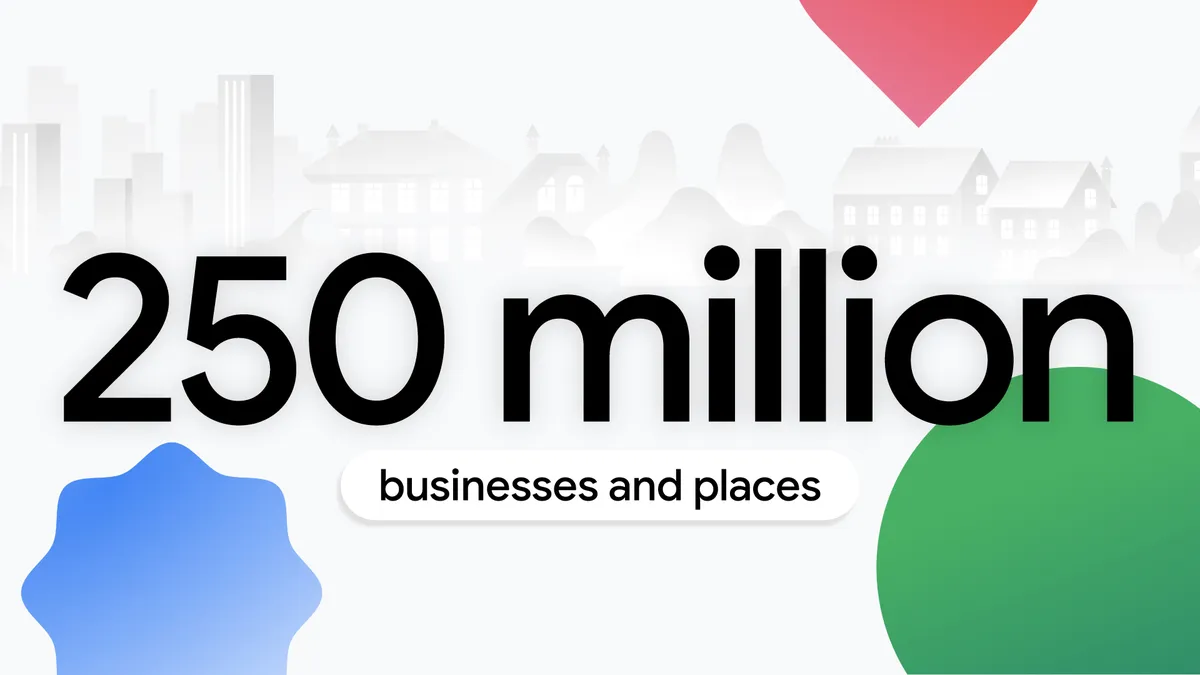 Figure 1: Google's own count of the businesses and places on its map, published for Maps' 20th birthday. Every one of those listings competes for the same few spots in the map pack. Source: Google, Google Maps celebrates 20 years, Feb 2025. Chart published by the source.
How many people and places are on Google Maps?
- Google Maps was "the latest product to surpass the 2 billion user milestone" (Alphabet, Q3 2024 earnings remarks, Oct 2024).
- 500 million users contribute to the map each year, and 100 million updates are made to it each day (Google, Google Maps celebrates 20 years, Feb 2025).
- In March 2026 Google said Maps analyzes information from over 300 million places, including reviews from more than 500 million contributors. The wording differs from the place count in the Key Takeaways, so it should not be read as growth (Google, How we're reimagining Maps with Gemini, Mar 2026).
- There are 36,207,130 small businesses in the United States, 99.9% of all businesses. That is the pool of firms that could claim a profile (US SBA Office of Advocacy, Frequently Asked Questions About Small Business 2026, Feb 2026).
How many connections do profiles send businesses?
- In 2019 Google said it connects people to businesses more than nine billion times a month on Maps, including more than one billion phone calls and three billion requests for directions (Google, How we fight fake business profiles, Jun 2019).
- In 2020 Google said local results in Search drive more than 4 billion connections a month, including more than 2 billion website visits, and connect people with more than 120 million businesses that don't have a website (Google, Organizing the world's information, Dec 2020). These two counts measure different things and are not a trend.
- Across 45,000 listings, the average business was found in 1,009 searches a month, and 84% of those were discovery searches for a category or service rather than the business name. The data is from 2017 and 2018 (BrightLocal, Google My Business Insights Study, Jul 2019).
- 15% of US consumers go to Google Maps first for a local search, and map apps together are the default for 20% (BrightLocal, Consumer Search Behavior, Apr 2025).
How many small businesses use a profile well?
- 63% of small businesses with a profile manage it themselves (BrightLocal, SMB Marketing Report 2026 ch. 1, Oct 2026).
- 30% of owners updated their profile in the last week and 72% in the last three months, but 21% had not touched it for more than three months (BrightLocal, SMB Marketing Report 2026 ch. 1, Oct 2026).
- Only 22% of owners named Google as one of their top two sources of new customers, even though 71% of consumers used Google at some point in their last local search (BrightLocal, SMB Marketing Report 2026 ch. 1, Oct 2026).
- Across 2,751 multi-location brands, Google profile completeness averages 86.6%, and brands appear in Google's local 3-pack 35.9% of the time (SOCi, Local Visibility Benchmarks 2026, Aug 2026).
Do AI assistants read Business Profiles?
- In 1.9 million AI citations for local prompts, Google Business Profile made up 28.5% of all citations and Yelp 8.53% (BrightLocal, Top sources and directories for local AI search, Aug 2026).
- In 6.8 million AI citations, listings drove 42% and first-party websites 44%; OpenAI leaned on listings for 48.7% of its citations (Yext, 86% of AI Citations Come from Brand-Managed Sources, Oct 2025).
- Locations that ChatGPT recommends average a 4.3 star rating, and those Perplexity recommends average 4.2 (SOCi, Local Visibility Benchmarks 2026, Aug 2026).
How many reviews are on Google, and who writes them?
Reviews are the part of the profile customers read hardest and owners neglect most. The gap between what customers want and what businesses have is wide.
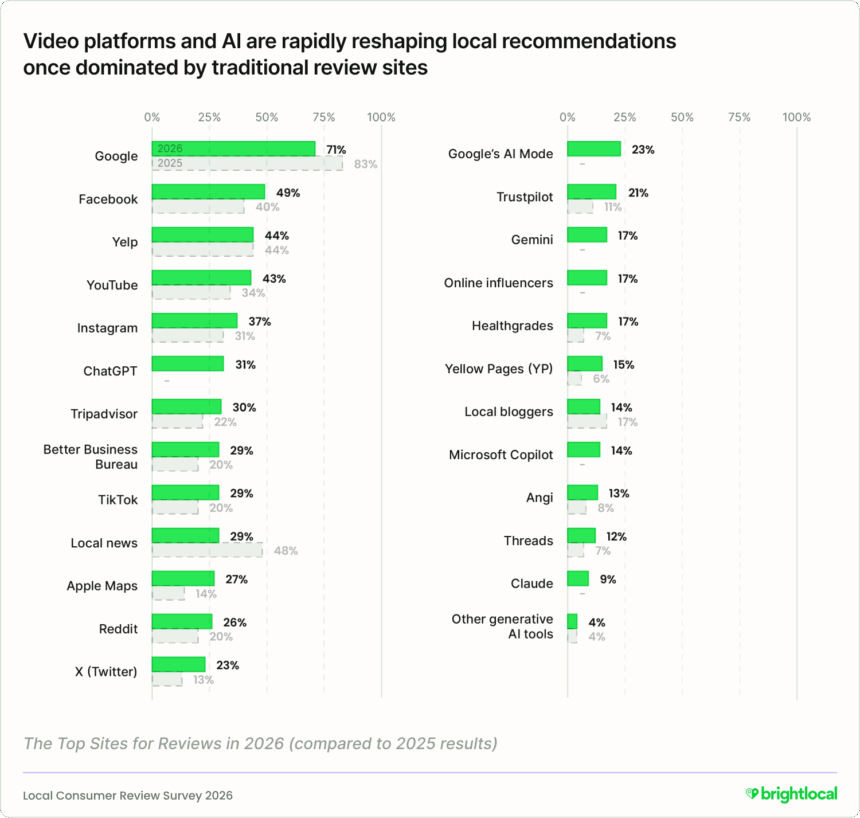 Figure 2: Google is still the review site most people use, but its lead shrank in a single year while Apple Maps, video and AI tools grew. A profile is no longer the only place a business gets judged. Source: BrightLocal, Local Consumer Review Survey 2026, Feb 2026. Chart published by the source.
How many people read reviews?
- 82% of US adults at least sometimes read online ratings or reviews before buying something for the first time, and 40% always or almost always do (Pew Research Center, Online reviews, Dec 2016).
- Of those who read reviews, 51% say they give an accurate picture, but 48% say it is often hard to tell if they are truthful and unbiased (Pew Research Center, Online reviews, Dec 2016).
- 97% of consumers read reviews for local businesses, and 41% "always" do, up from 29% a year earlier (BrightLocal, Local Consumer Review Survey 2026, Feb 2026).
- 99% of consumers read reviews before a first visit at least some of the time, and 68% do so always or most of the time (SOCi, 2026 Local Discovery Index, Sep 2026).
Who is leaving Google reviews?
- 45% of consumers left a Google review in the past year, and Google's share as a review source dipped from 83% in 2025 to 71% (BrightLocal, Local Consumer Review Survey 2026, Feb 2026).
- 78% of consumers were asked to leave a review in the last 12 months, and 28% say they always write one when asked, up from 16% in 2025 (BrightLocal, Local Consumer Review Survey 2026, Feb 2026).
- In one case study, the average one-star Google review was 244 words long and the average five-star review 74 words (Sterling Sky, Does the length of a Google review matter?, Sep 2026).
What do customers expect from reviews?
- 74% of consumers only care about reviews written in the last three months, and 31% will only use a business rated 4.5 stars or more, up from 17% a year earlier (BrightLocal, Local Consumer Review Survey 2026, Feb 2026).
- 89% of consumers expect business owners to respond to reviews (BrightLocal, Local Consumer Review Survey 2026, Feb 2026).
- 80% say they are likely to use a business that responds to all its reviews, while templated or generic replies make 50% unlikely to choose a business (BrightLocal, Local Consumer Review Survey 2026, Feb 2026).
- 19% of consumers expect a reply on the same day they post a review, and 81% expect one within a week (BrightLocal, Local Consumer Review Survey 2026, Feb 2026).
- 72% of consumers are more likely to choose a business that responds to its reviews, up from 65% in 2025 (SOCi, 2026 Local Discovery Index, Sep 2026).
How do businesses handle reviews?
- Only 51% of small business owners actually respond to reviews, and 64% ask for reviews regularly, in a survey of 1,000 US small business owners (BrightLocal, SMB Marketing Report 2026 ch. 2, Oct 2026).
- Only 16% of small businesses have more than 50 Google reviews; 14% do nothing to manage their Google reviews, and 6% didn't know they could respond to them (BrightLocal, SMB Marketing Report 2026 ch. 2, Oct 2026).
- In a benchmark of 2,751 multi-location brands and about 350,000 locations, the average brand responds to 46.9% of its Google reviews and 3.1% of its Yelp reviews (SOCi, Local Visibility Benchmarks 2026, Aug 2026).
- Across 8,952 businesses in six verticals, every vertical received fewer first-party reviews in 2025 than in 2024 (GatherUp, 2025 Reputation Benchmarks, Feb 2026).
- Asking for reviews lifted average star ratings in 2025: from 4.0 to 4.3 for legal firms and from 3.8 to 4.1 for construction (GatherUp, 2025 Reputation Benchmarks, Feb 2026).
Does the number of reviews move rankings?
- In three test cases, businesses saw a small but noticeable Maps ranking increase when they went from 9 to 10 reviews, with no similar bump from 10 to 11. Three businesses is a very small sample (Sterling Sky, Does the number of Google reviews impact ranking?, Apr 2025).
- In 50.4 million US local pack results, the median business in the 3-pack had 215 reviews for plumbers, 244 for HVAC contractors, 153 for personal injury lawyers and 56 for electricians (Local Falcon, What 50 Million Search Results Reveal About Ranking in the Local 3-Pack, Jan 2026).
- The same study found the typical 3-pack winner has 4.8 to 4.9 stars, and metro areas need roughly 1.5 to 2 times as many reviews as rural ones (Local Falcon, What 50 Million Search Results Reveal About Ranking in the Local 3-Pack, Jan 2026).
- A client that had not had a new review in over 3 years was filtered out for keywords it used to rank well for (Sterling Sky, Review recency case study, Jul 2025).
- A dental client that had been getting 60+ reviews a month stopped for 18 days, and its rankings dropped (Sterling Sky, What gets you ranking for "near me", Nov 2025).
What can a Business Profile hold?
The rules are tighter than most owners think, and several features have quietly been switched off. Knowing the limits saves a business from suspensions and wasted effort.
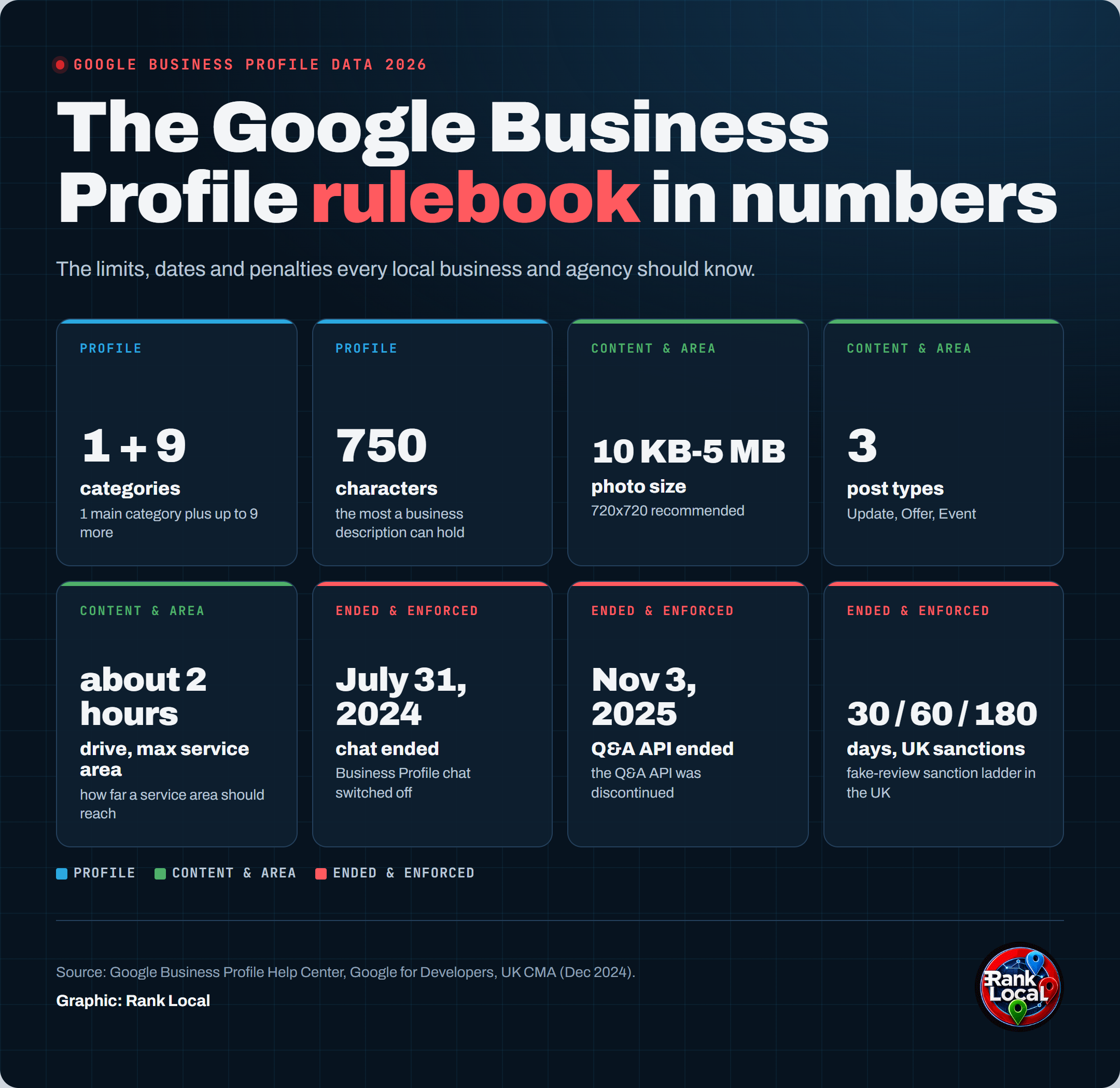 Figure 3: The limits, dates and penalties that shape every Business Profile, gathered on one card. Source: Google Business Profile Help, Guidelines for representing your business, Nov 2026; Google Business Profile Help, bulk upload spreadsheet, Nov 2026; Google Business Profile Help, Edit your Business Profile, Nov 2026; Google Business Profile Help, Tips for business-specific photos, Nov 2026; Google Business Profile Help, Create and manage posts, Nov 2026; Google Business Profile Help, Changes to chat and call history, Jul 2024; Google for Developers, Q&A API change log, Aug 2026; UK CMA, Google's undertaking to the CMA, Dec 2024. Graphic by Rank Local from those sources.
What are the limits on categories, descriptions and photos?
- Google says to "choose the fewest number of categories it takes to describe your overall core business" (Google Business Profile Help, Guidelines for representing your business, Nov 2026).
- "Do not exceed 750 characters in the description field" (Google Business Profile Help, Edit your Business Profile, Nov 2026).
- Photos must be between 10 KB and 5 MB, with 720 x 720 px recommended and 250 x 250 px the minimum. Bulk photo upload is for 10 or more locations (Google Business Profile Help, Tips for business-specific photos, Nov 2026).
- Posts come in three types: Update, Offer and Event (Google Business Profile Help, Create and manage posts, Nov 2026).
- 85% of consumers say contact details and opening hours are an important factor when they research a local business (BrightLocal, Consumer Search Behavior, Apr 2025).
What are the rules for service areas?
- A service area "shouldn't extend farther than about 2 hours of driving time", and a virtual office isn't eligible for a profile (Google Business Profile Help, Guidelines for representing your business, Nov 2026).
- "You can't set your service area as a radius distance around your business", and edits may take up to 48 hours to show (Google Business Profile Help, Manage your service areas, Nov 2026).
Which features have been switched off?
- "As of July 31, 2024, the chat and call history features are no longer available in your Business Profile" (Google Business Profile Help, Changes to chat and call history, Jul 2024).
- "The My Business Q&A API was discontinued on November 3, 2025." Google has documented only the API date, not a full end to Q&A (Google for Developers, Q&A API change log, Aug 2026).
What do profiles actually deliver: calls, directions or clicks?
The profile is becoming the destination instead of the doorway. Fewer people click through to the website or call straight from the listing, and more ask for directions.
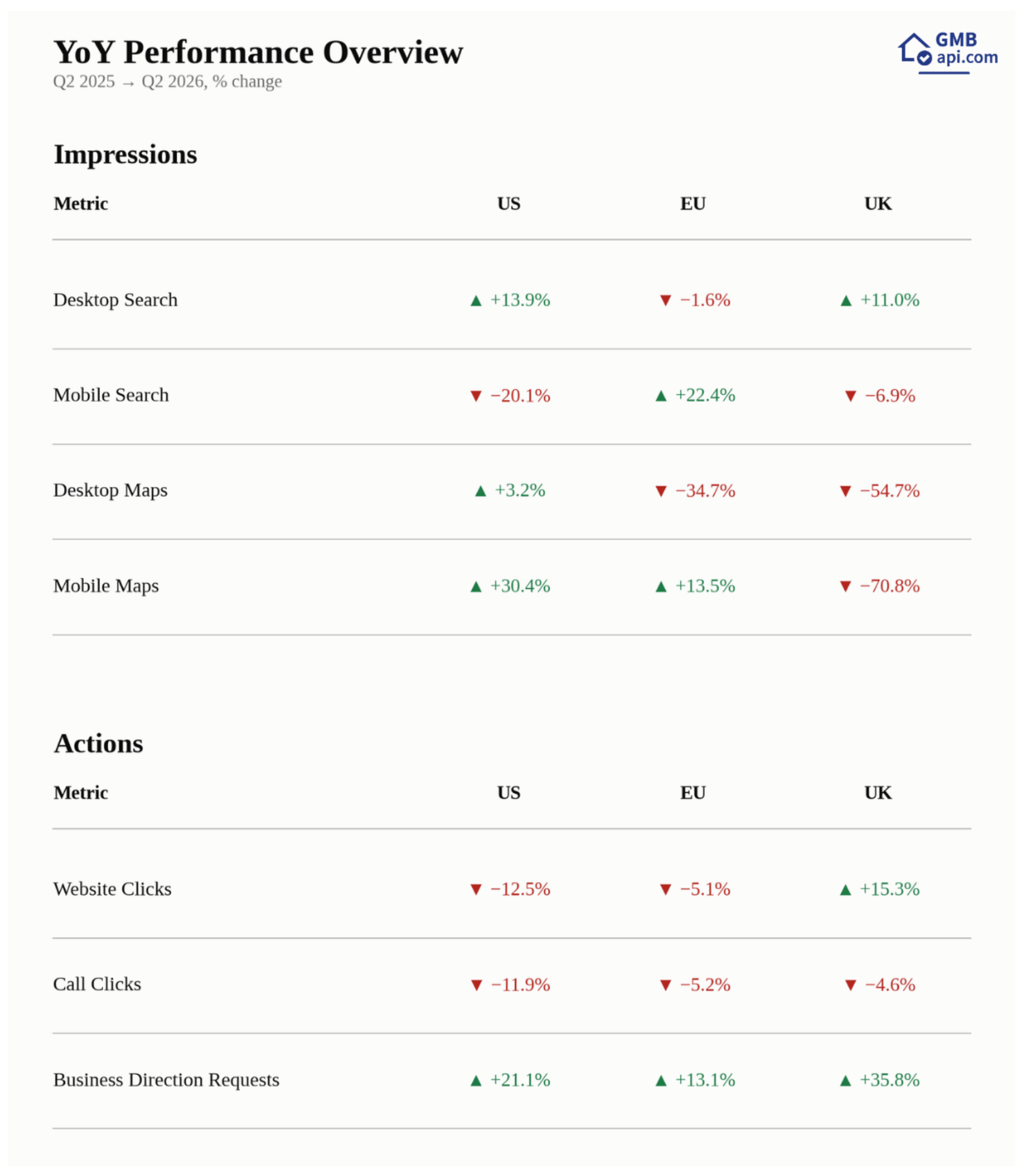 Figure 4: One vendor's portfolio of profiles shows calls and website clicks falling in the US while direction requests keep rising. The business still gets found; it just gets fewer of the actions it can track. Source: Search Engine Land, GMBapi data, Aug 2026. Screenshot of the source page, captured 2 Nov 2026.
Which actions does Google count?
- Google's performance report counts interactions, searches, views, directions, calls, website clicks, messages and bookings, and includes actions from both organic results and Google Ads (Google Business Profile Help, Understand your performance and insights, Nov 2026).
- In 2017 and 2018 data, only 5% of profile views turned into a website click, call or direction request; a typical business got 59 actions a month, 56% of them website visits (BrightLocal, Google My Business Insights Study, Jul 2019).
How did calls, clicks and directions change in 2026?
- In Q2 2026, compared with Q2 2025, calls were down 11.9% and website clicks down 12.5%, while direction requests were up 21.1%. This is one vendor's portfolio of profiles, not a random sample, and the author says an earlier Q1 reading was revised (Search Engine Land, GMBapi data, Aug 2026).
- In the same data, US mobile Search impressions fell 20.6% in Q1 while desktop Search impressions rose 12.3%. In the EU, desktop Maps impressions fell 34.7% in Q2 (Search Engine Land, GMBapi data, Aug 2026).
- AI-powered local packs surfaced only 32% as many businesses as regular 3-packs (5,943 unique businesses against 18,330), and 88% of the 322 markets studied had fewer businesses in the AI version (Sterling Sky, Local SEO Updates 2026, Oct 2026).
- Local pack ads showed on 1% of Sterling Sky's mobile ranking reports at the start of 2025 and on almost 22% by December; Local Services Ads went from roughly 11% of tracked queries to 31% (Sterling Sky, Local SEO Updates 2026, Oct 2026).
What do people do after reading a profile's reviews?
- After reading positive reviews, 54% of consumers check the business's website. 66% go on to do more research, while 34% are ready to buy or book (BrightLocal, Local Consumer Review Survey 2026, Feb 2026).
- When an AI tool recommends a business, 81% of consumers take a verification step before contacting it (SOCi, 2026 Local Discovery Index, Sep 2026).
- In 540 manually checked queries for six local industries, AI Overviews appeared on 68% of local business-type queries on average (Whitespark, The prevalence of AI Overviews in local search, May 2025).
How many fake reviews and fake profiles does Google remove?
Google removes more fake reviews every year, which tells you two things: enforcement is getting better, and the fakers are not giving up. Home service trades are among the most attacked.
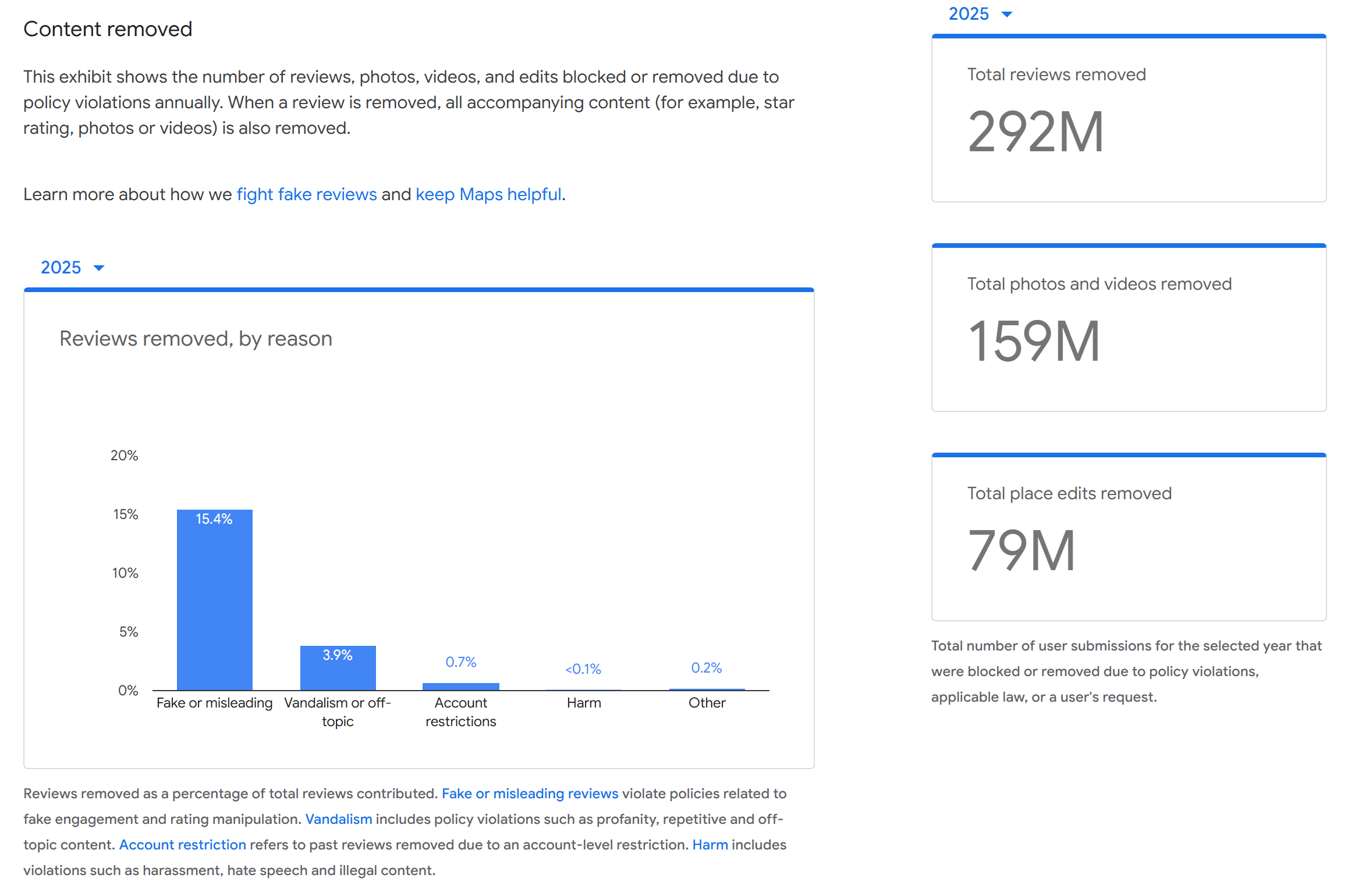 Figure 5: Google's own dashboard of what it pulled off Maps in 2025. Fake or misleading content is one of the biggest reasons reviews come down, which is why a sudden burst of reviews puts a profile at risk. Source: Google Maps Content Trust & Safety Report, Nov 2026. Screenshot of the source page, captured 2 Nov 2026.
How many reviews has Google removed each year?
- 2020: 55 million policy-violating reviews blocked or removed and nearly 3 million fake profiles, which Google said was 20 million fewer reviews than in 2019 (Google, Maps 101, Feb 2021).
- 2021: more than 95 million reviews and more than 7 million fake profiles removed, more than 630,000 of them reported directly by people (Google, How we kept information on Maps reliable in 2021, Mar 2022).
- 2022: over 115 million reviews, and 20 million attempts to create fake profiles stopped, 8 million more than in 2021 (Google, New ways we tackle fake contributions, Mar 2023).
- 2023: over 170 million reviews, over 45% more than in 2022, and more than 12 million fake profiles removed or blocked (Google, How machine learning keeps contributed content helpful, Feb 2024).
- 2024: more than 240 million reviews and more than 12 million fake profiles. Google also removed over 10,000 listings run by one group impersonating real locksmiths (Google, Google Maps uses AI to fight fake Business Profiles, Apr 2025).
- 2025: Google also blocked 79 million inaccurate or unverified edits and put posting restrictions on more than 782,000 accounts (Google, New ways we're protecting businesses on Maps, Apr 2026).
What share of reviews is fake?
- Google's Transparency Report shows 15.4% of contributed reviews removed as fake or misleading and 159M photos and videos removed. The dashboard has a year selector and no date; the figures match Google's 2025 totals (Google Maps Content Trust & Safety Report, Nov 2026).
- Google revised its own 2024 numbers in March 2026: place edits removed went from 70M to 82M (Google Transparency Report Help, visible changes, Mar 2026).
- In 2021 Google said fraudulent or abusive content is less than one percent of all content viewed on Maps (Google, How we kept information on Maps reliable in 2021, Mar 2022).
- The Transparency Company estimates review fraud in home services, legal and medical costs US consumers about $300 billion a year, or $2,385 per household (The Transparency Company, The High Cost of Review Fraud, Dec 2024).
What do other review platforms remove?
- Yelp received 22 million reviews in 2025; 11% were removed by its User Operations team, and its systems filtered out nearly 500,000 suspected AI-generated reviews (Yelp, Trust & Safety Report 2025, Feb 2026).
- Yelp rejected 50,700+ potential new business pages for spammy behavior in 2025, a 29% increase on 2024, much of it in high-risk emergency categories such as locksmiths (Yelp, Trust & Safety Report 2025, Feb 2026).
- Trustpilot removed 4.5 million fake reviews in 2024, 7.4% of all reviews submitted (6.1% in 2023), and 90% of them were caught automatically (Trustpilot, Trust Report 2025, May 2025).
Which businesses get attacked?
- In Google-backed research on data from 2014-2015, locksmiths alone were 25.7% of abusive listings, and the median time between a fake listing's creation and suspension was 8.6 days (Huang et al., Pinning Down Abuse on Google Maps, Apr 2017).
- One bad actor Google sued had posted more than 350 fraudulent profiles backed by more than 14,000 fake reviews (Google, We're taking legal action to stop fake review scams, Jun 2023).
- Google warns that extortion scams may start with "a sudden increase in 1-star and 2-star reviews ... followed by someone demanding money", and has a dedicated report form (Google Business Profile Help, Report negative review extortion scams, Nov 2026).
- A profile caught with fake engagement may be blocked from new reviews for a set time, have existing reviews unpublished and show a warning (Google Business Profile Help, Business Profile restrictions, Nov 2026).
Can fake reviews be spotted?
- Researchers built a public set of almost 18,000 fake and genuine Google Maps reviews from Poland; their models reached an F1 score of 0.92 for spotting fake accounts but only 0.74 for single fake reviews (Gryka and Janicki, Detecting Fake Reviews in Google Maps: A Case Study, May 2023).
- AI-generated reviews have grown 80% month over month since June 2023, according to the same review fraud analysis (The Transparency Company, The High Cost of Review Fraud, Dec 2024).
- 63% of consumers think review platforms should be responsible for detecting and preventing fake reviews, and 25% think it is a job for government (BrightLocal, Local Consumer Review Survey 2026, Feb 2026).
What does the law say about fake reviews?
Fake reviews are no longer just against Google's rules. In the US, the UK and the EU they are a legal problem, with real fines attached.
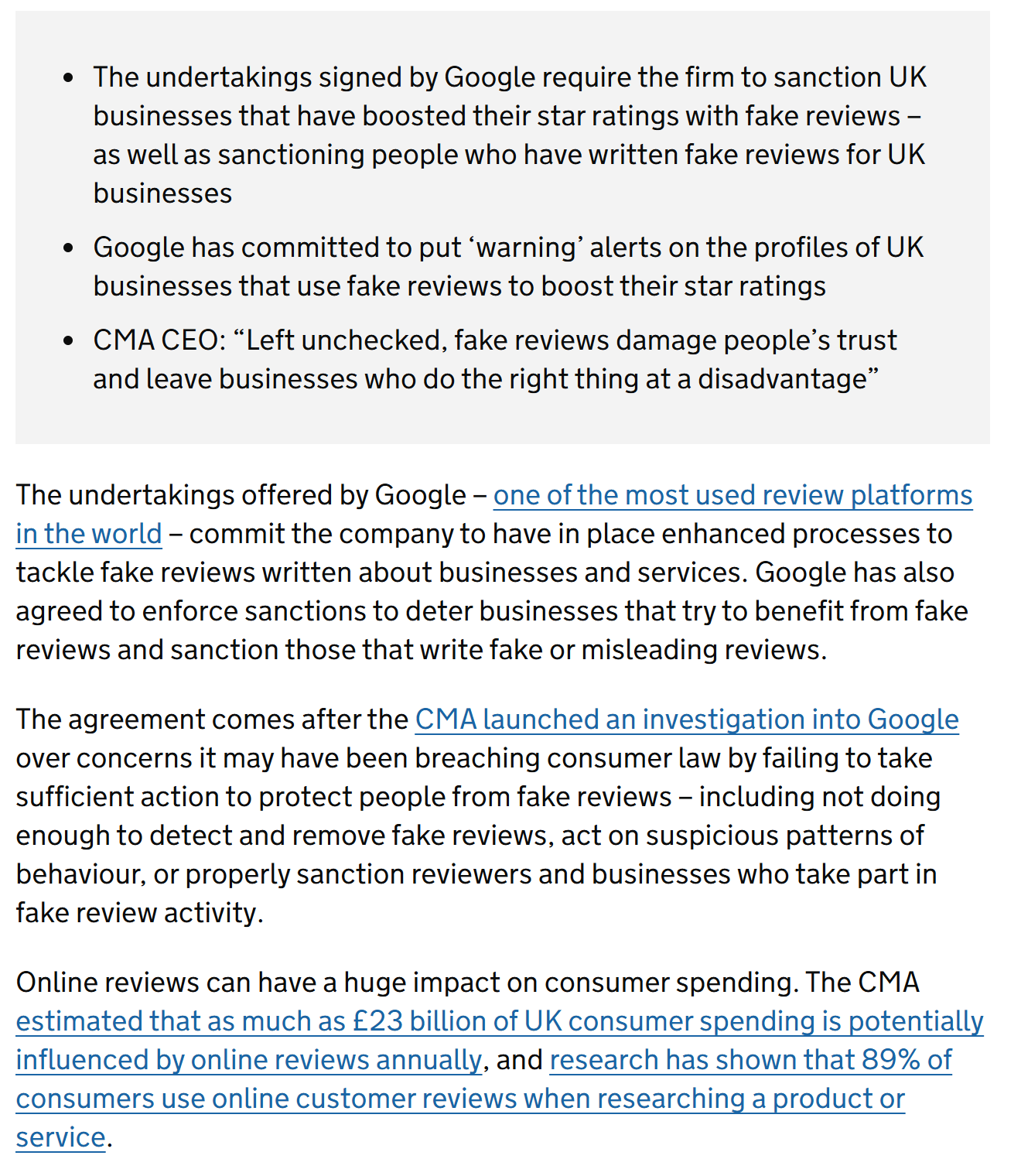 Figure 6: The UK regulator's announcement that Google must sanction businesses and reviewers caught faking reviews. It is the first time a regulator has written Business Profile penalties into a binding agreement. Source: UK CMA, changes from Google to tackle fake reviews, Jan 2025. Screenshot of the source page, captured 2 Nov 2026.
What are the US rules?
- The FTC's final rule bans fake reviews "such as AI-generated fake reviews", buying positive or negative reviews and undisclosed insider reviews. The Commission vote was 5-0 (FTC, Final Rule Banning Fake Reviews and Testimonials, Aug 2024).
- The rule took effect on October 21, 2024, after the proposal drew 100 responsive comments (Federal Register, Trade Regulation Rule on the Use of Consumer Reviews and Testimonials, Aug 2024).
- The FTC sent letters to 10 companies about possible violations, warning of civil penalties of up to $53,088 per violation (FTC, warning letters to 10 companies, Dec 2025).
- The FTC voted 5-0 to charge review platform Sitejabber with inflating ratings using reviews collected before customers had received what they bought; the inflated ratings also showed in Google search results (FTC, Order against AI-enabled review platform Sitejabber, Nov 2024).
- The FTC approved a final order against AI review writer Rytr by a 3-2 vote (FTC, Final order against Rytr, Dec 2024), then set that order aside a year later by a 2-0 vote (FTC, Rytr order set aside, Dec 2025). Tools that write reviews are not banned; posting fake ones still is.
- 11% of consumers were offered an incentive to write a positive review in the past year, which the FTC rule forbids (BrightLocal, Local Consumer Review Survey 2026, Feb 2026).
What have state attorneys general done?
- New York's "Operation Clean Turf" ended with 19 companies agreeing to stop writing fake reviews and pay more than $350,000; some paid writers $1 to $10 per review (New York Attorney General, agreement with 19 companies, Sep 2013).
- California, the FTC and five other states settled with a rental app that bought thousands of fake positive reviews: $1.6 million paid and a suspended judgment of more than $47 million (California Attorney General, Roomster settlement, Aug 2023).
What are the UK and EU rules?
- Google agreed to report to the CMA over a 3-year period, and the CMA estimates £23 billion a year of UK consumer spending is potentially influenced by online reviews (UK CMA, changes from Google to tackle fake reviews, Jan 2025).
- Under Google's undertaking, a business's first sanction is a consumer alert for at least 30 days plus a block on new reviews; a repeat means at least 60 days with all reviews hidden; a third, at least 180 days (UK CMA, Google's undertaking to the CMA, Dec 2024).
- The Digital Markets, Competition and Consumers Act 2024 created a new banned practice covering fake reviews and concealed incentivised reviews (UK CMA, Fake reviews guidance CMA208, Apr 2025).
- The CMA's new enforcement regime came into effect on 6 April 2025, and Amazon gave its own undertakings in June 2025 (UK CMA, Amazon gives undertakings to curb fake reviews, Jun 2025).
- In an EU-wide sweep of 223 major websites, authorities could not confirm that 144 were doing enough to keep reviews authentic, and at least 55% potentially broke EU law (European Commission, Protecting consumers from misleading reviews, Jan 2022).
What do consumers want done?
- 97% of consumers think businesses should be punished for fake reviews: 57% want them banned from review platforms and 16% want criminal charges (BrightLocal, Local Consumer Review Survey 2026, Feb 2026).
What drives map pack rankings?
Google names three things and gives no weights. Practitioners have tested the pieces, and their findings line up with Google's list more than with the myths.
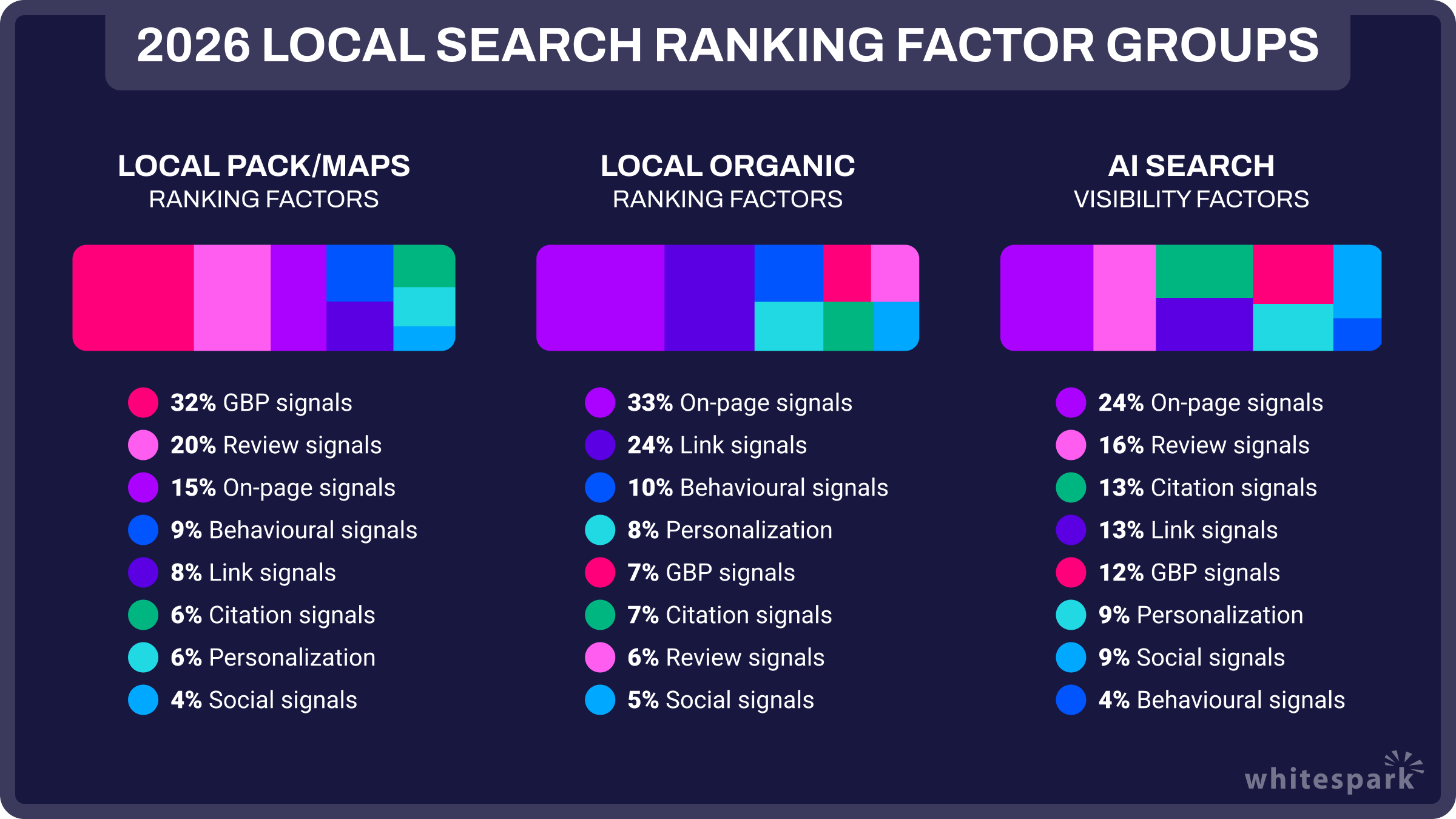 Figure 7: How 47 local search experts split the weight of map pack ranking signals, next to their splits for organic and AI search. The profile and its reviews carry about half of the map pack weight, and almost none of the AI search weight. Source: Whitespark, Local Search Ranking Factors 2026, Nov 2025. Chart published by the source.
What does Google say?
- "Local results are mainly based on relevance, distance, and popularity", with prominence "based on info like how many websites link to your business and how many reviews you have" (Google Business Profile Help, Tips to improve your local ranking, Nov 2026).
What do experts weight?
- The same expert survey puts on-page signals at 15%, behavioural 9%, links 8%, citations 6%, personalization 6% and social 4%, and ranks the primary Business Profile category as the #1 map pack factor (score 227). This is opinion, not measured data (Whitespark, Local Search Ranking Factors 2026, Nov 2025).
- Among negative factors, the experts rank a business marked as permanently closed first (score 217) and an incorrect primary category second (score 214) (Whitespark, Local Search Ranking Factors 2026, Nov 2025).
What have practitioners tested?
- Removing business hours had a noticeable negative effect on rankings during the hours the business was open (Sterling Sky, Is listing your business hours crucial for rankings?, Mar 2025).
- Adding Google posts had no measurable impact on local pack rankings (Sterling Sky, Do Google Posts impact ranking?, Jul 2021).
- Across 8,186 businesses in 200 cities, hiding the address correlated negatively with ranking well in the local pack (Sterling Sky, What gets you ranking for "near me", Nov 2025).
- Adding pre-defined services to a profile improved rankings for related keywords, with the effect showing within 24 to 72 hours (Sterling Sky, Do services in Google Business Profile impact ranking?, Sep 2026).
Methodology and Sources
We used only primary sources: Google's own blog posts, Help Center, Transparency Report and developer documents; regulators and prosecutors (the FTC, the Federal Register, the New York and California attorneys general, the UK CMA, the European Commission); the US Small Business Administration; Pew Research Center; two peer-reviewed papers; platform trust reports (Yelp, Trustpilot); and studies that publish their method. No statistics roundup pages were cited. Every source was opened on 2 November 2026. Google's enforcement numbers are floors and its way of counting fake profiles changes between years; we quote its wording each time. Help Center pages and the Transparency Report dashboard carry no publish date, so the date shown is the month we checked them. Figure 3 is a Rank Local graphic built from the sources in its caption; every other figure is the source's own chart or a screenshot of the source page, captured on 2 November 2026, with the date of the data in the caption. Some sources sell local SEO or review software (BrightLocal, Whitespark, SOCi, GatherUp, GMBapi, Local Falcon, Yext, Sterling Sky as an agency); we cite them as the researchers. This page is reviewed monthly.
Sources
- Google, Google Maps celebrates 20 years: https://blog.google/products-and-platforms/products/maps/20-years-google-maps-20-features
- Google, New ways we're protecting businesses on Maps: https://blog.google/products-and-platforms/products/maps/new-ways-were-protecting-businesses-on-maps/
- Google, Google Maps uses AI to fight fake Business Profiles: https://blog.google/products-and-platforms/products/maps/google-business-profiles-ai-fake-reviews/
- Google, How machine learning keeps contributed content helpful: https://blog.google/products-and-platforms/products/maps/how-machine-learning-keeps-contributed-content-helpful
- Google, New ways we tackle fake contributions: https://blog.google/products-and-platforms/products/maps/google-maps-fake-contributions-ai-machine-learning/
- Google, How we kept information on Maps reliable in 2021: https://blog.google/products-and-platforms/products/maps/how-we-kept-maps-reliable-2021
- Google, Maps 101: https://blog.google/products-and-platforms/products/maps/google-maps-101-how-we-tackle-fake-and-fraudulent-contributed-content/
- Google, How we fight fake business profiles: https://blog.google/products-and-platforms/products/maps/how-we-fight-fake-business-profiles-google-maps/
- Google, Organizing the world's information: https://blog.google/products/search/information-sources-google-search/
- Google, legal action to stop fake review scams: https://blog.google/company-news/outreach-and-initiatives/public-policy/legal-action-stop-fake-review-scams/
- Google, How we're reimagining Maps with Gemini: https://blog.google/products-and-platforms/products/maps/ask-maps-immersive-navigation
- Alphabet, Q3 2024 earnings remarks: https://blog.google/company-news/inside-google/message-ceo/alphabet-earnings-q3-2024
- Google Maps Content Trust & Safety Report: https://transparencyreport.google.com/maps-content/enforcement?hl=en
- Google Transparency Report Help, visible changes: https://support.google.com/transparencyreport/answer/16939440?hl=en
- Google Business Profile Help pages: 7091, 3370250, 3038177, 3039617, 6123536, 9918094, 7342169, 14114287, 16404809, 14919056, 9157481 (https://support.google.com/business/answer/<number>?hl=en)
- Google for Developers, Q&A API change log: https://developers.google.com/my-business/content/qanda/change-log
- Huang et al., Pinning Down Abuse on Google Maps: https://research.google.com/pubs/archive/b1fac3ff95e2724d295d2c2544e99c24b9dee52b.pdf
- FTC, Final Rule Banning Fake Reviews and Testimonials: https://www.ftc.gov/news-events/news/press-releases/2024/08/federal-trade-commission-announces-final-rule-banning-fake-reviews-testimonials
- Federal Register, Trade Regulation Rule on the Use of Consumer Reviews and Testimonials: https://www.federalregister.gov/documents/2024/08/22/2024-18519/trade-regulation-rule-on-the-use-of-consumer-reviews-and-testimonials
- FTC, warning letters to 10 companies: https://www.ftc.gov/news-events/news/press-releases/2025/12/ftc-warns-10-companies-about-possible-violations-agencys-new-consumer-review-rule
- FTC, Order against AI-enabled review platform Sitejabber: https://www.ftc.gov/news-events/news/press-releases/2024/11/ftc-order-against-ai-enabled-review-platform-sitejabber-will-ensure-consumers-get-truthful-accurate
- FTC, Final order against Rytr: https://www.ftc.gov/news-events/news/press-releases/2024/12/ftc-approves-final-order-against-rytr-seller-ai-testimonial-review-service-providing-subscribers
- FTC, Rytr order set aside: https://www.ftc.gov/news-events/news/press-releases/2025/12/ftc-reopens-sets-aside-rytr-final-order-response-trump-administrations-ai-action-plan
- New York Attorney General, agreement with 19 companies: https://ag.ny.gov/press-release/2013/ag-schneiderman-announces-agreement-19-companies-stop-writing-fake-online-reviews
- California Attorney General, Roomster settlement: https://oag.ca.gov/news/press-releases/attorney-general-bonta-announces-settlement-room-rental-app-purchasing-fake
- UK CMA, changes from Google to tackle fake reviews: https://www.gov.uk/government/news/cma-secures-important-changes-from-google-to-tackle-fake-reviews
- UK CMA, Google's undertaking: https://assets.publishing.service.gov.uk/media/67924902e982ca138427fc1e/Google_s_undertaking_to_the_CMA.pdf
- UK CMA, Fake reviews guidance CMA208: https://assets.publishing.service.gov.uk/media/67eeb64fe9c76fa33048c790/CMA208_-_Fake_reviews_guidance.pdf
- UK CMA, Amazon gives undertakings to curb fake reviews: https://www.gov.uk/government/news/amazon-gives-undertakings-to-cma-to-curb-fake-reviews
- European Commission, Protecting consumers from misleading reviews: https://ec.europa.eu/commission/presscorner/detail/en/ip_22_394
- US SBA Office of Advocacy, Frequently Asked Questions About Small Business 2026: https://advocacy.sba.gov/2026/02/03/frequently-asked-questions-about-small-business-2026/
- Pew Research Center, Online reviews: https://www.pewresearch.org/internet/2016/12/19/online-reviews/
- Gryka and Janicki, Detecting Fake Reviews in Google Maps: A Case Study: https://www.mdpi.com/2076-3417/13/10/6331
- Yelp, Trust & Safety Report 2025: https://trust.yelp.com/trust-and-safety-report/2025-report
- Trustpilot, Trust Report 2025: https://corporate.trustpilot.com/trust/trust-report-2025
- The Transparency Company, The High Cost of Review Fraud: https://askfortransparency.com/research/high-cost-of-review-fraud/
- Whitespark, Local Search Ranking Factors 2026: https://whitespark.ca/local-search-ranking-factors/
- Whitespark, The prevalence of AI Overviews in local search: https://whitespark.ca/blog/case-study-the-prevalence-of-ai-overviews-in-local-search/
- Sterling Sky, number of reviews and ranking: https://www.sterlingsky.ca/number-of-reviews-impact-ranking/
- Sterling Sky, review recency case study: https://www.sterlingsky.ca/google-review-recency-ranking/
- Sterling Sky, length of a Google review: https://www.sterlingsky.ca/length-google-review-matter/
- Sterling Sky, business hours and rankings: https://www.sterlingsky.ca/is-listing-business-hours-crucial-for-rankings/
- Sterling Sky, Google Posts and ranking: https://www.sterlingsky.ca/do-google-posts-impact-ranking/
- Sterling Sky, near me study: https://www.sterlingsky.ca/what-gets-you-ranking-for-near-me-2025/
- Sterling Sky, services and ranking: https://www.sterlingsky.ca/services-in-google-business-profile-impact-ranking/
- Sterling Sky, Local SEO Updates 2026: https://www.sterlingsky.ca/the-state-of-local-seo-in-2026/
- Local Falcon, What 50 Million Search Results Reveal About Ranking in the Local 3-Pack: https://www.localfalcon.com/research/whitepaper-google-reviews-ratings--location-what-50-million-search-results-reveal-about-ranking-in-the-local-3pack
- BrightLocal, Local Consumer Review Survey 2026: https://www.brightlocal.com/research/local-consumer-review-survey/
- BrightLocal, SMB Marketing Report 2026 ch. 1: https://www.brightlocal.com/research/smb-report-google/
- BrightLocal, SMB Marketing Report 2026 ch. 2: https://www.brightlocal.com/research/smb-report-enough-reviews/
- BrightLocal, Google My Business Insights Study: https://www.brightlocal.com/research/google-my-business-insights-study/
- BrightLocal, Consumer Search Behavior: https://www.brightlocal.com/research/consumer-search-behavior/
- BrightLocal, Top sources and directories for local AI search: https://www.brightlocal.com/resources/ai-directory-sources/
- Search Engine Land, GMBapi data: https://searchengineland.com/calls-clicks-falling-google-maps-destination-486276
- SOCi, Local Visibility Benchmarks 2026: https://soci.ai/blog/local-visibility-benchmarks
- SOCi, 2026 Local Discovery Index: https://soci.ai/blog/ai-local-search-verification-loop
- GatherUp, 2025 Reputation Benchmarks: https://gatherup.com/blog/2025-reputation-benchmarks
- Yext, 86% of AI Citations Come from Brand-Managed Sources: https://www.yext.com/about/news-media/ai-citations-release
Glossary
- Google Business Profile (GBP): the free listing that puts a business on Google Maps and in the map pack.
- Map pack (local pack, 3-pack): the box of usually three businesses with a map that Google shows for local searches.
- Service-area business: a business that hides its street address and lists the areas it serves instead.
- FTC: the US Federal Trade Commission. CMA: the UK Competition and Markets Authority. SBA: the US Small Business Administration.
- API: the connection software tools use to read and update profiles automatically.
- AI Overview: the AI-written summary Google shows above some search results.
- F1 score: a measure of how accurately a model sorts items into two groups, from 0 (useless) to 1 (perfect).