How Google Map Rankings Change With Distance: A Rank Local Study (2026)
Updated November 2026
Every local business owner has seen it. Search from the shop and the business is #1. Drive across town, search again, and it is gone. We wanted to know how fast that happens, so we measured it.
We used Google Maps grid scans for 21 local businesses: 15,295 map points, each one a real Google Maps search run from a set spot on a grid around the business between October 31 and November 1, 2026. For every point we recorded where the business ranked and how far that spot was from the center of its grid.
The short answer: within a mile, a business ranked in the top 3 on about 2 in 3 points. Eight miles or more out, it was about 1 in 4.
This page is part of our local data section; the main page is local search statistics.
Key Takeaways
- Within 1 mile of the center of its scan grid, the business ranked in Google's map top 3 on 66.9% of points (Rank Local grid-scan study, Nov 2026).
- At 8 miles or more, that fell to 24.8% (Rank Local grid-scan study, Nov 2026).
- At 8 miles or more, the business was not in the top 20 at all on 35.3% of points, against 13.0% within a mile (Rank Local grid-scan study, Nov 2026).
- Top-3 share dropped at every distance band we could measure: 66.9%, 51.7%, 46.9%, 38.7%, 24.8% (Rank Local grid-scan study, Nov 2026).
- Top-10 share went from 81.8% within a mile to 47.1% at 8+ miles (Rank Local grid-scan study, Nov 2026).
- Study size: 21 businesses, 15,295 Google Maps points, farthest point 33.2 miles from the grid center (Rank Local grid-scan study, Nov 2026).
How fast does a map ranking fade with distance?
Distance is not a small factor in the map pack. It is the factor most businesses feel every day, and it shows up in the numbers band by band.
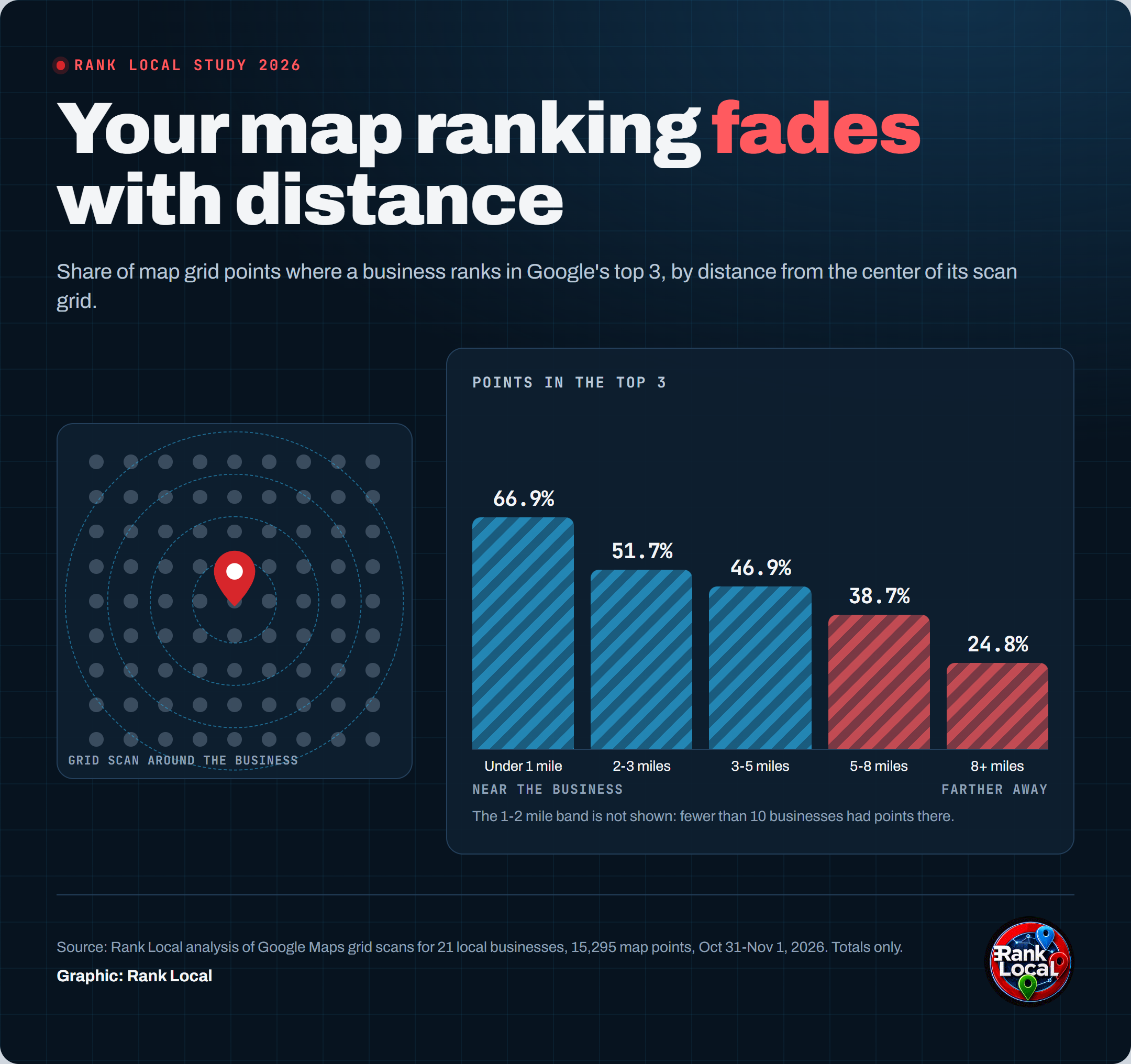 Figure 1: Top-3 share by distance band, from our own Google Maps grid scans. Source: Rank Local analysis of the newest grid scan for each of 21 local businesses, 15,295 points, Oct 31-Nov 1, 2026. Graphic by Rank Local. Google says local results are mainly based on relevance, distance and popularity (Google Business Profile Help, Tips to improve your local ranking, checked Nov 2026).
| Distance from the grid center | Businesses with points here | Map points | In the top 3 | In the top 10 | Not in the top 20 |
|---|---|---|---|---|---|
| Under 1 mile | 20 | 154 | 66.9% | 81.8% | 13.0% |
| 1-2 miles | 6 | hidden | hidden | hidden | hidden |
| 2-3 miles | 20 | 840 | 51.7% | 75.0% | 14.3% |
| 3-5 miles | 20 | 2,002 | 46.9% | 68.6% | 19.8% |
| 5-8 miles | 20 | 3,017 | 38.7% | 61.5% | 25.7% |
| 8+ miles | 21 | 9,198 | 24.8% | 47.1% | 35.3% |
The 1-2 mile band is hidden because only 6 businesses have points there (a result of how the scan grids are spaced). We never show a number built from fewer than 10 businesses.
What happens close to the business?
- Inside a mile, the business made the top 3 on 66.9% of points and the top 10 on 81.8%.
- Even this close, it was missing from the top 20 on 13.0% of points. Being near the searcher helps a lot, but it does not guarantee a spot.
What happens a few miles out?
- At 2-3 miles, top-3 share was 51.7% and top-10 share 75.0%.
- At 3-5 miles, top-3 share was 46.9%. At 5-8 miles it was 38.7%, and the business was outside the top 20 on 25.7% of points.
What happens across town?
- At 8 miles or more, where most grid points sit (9,198 of them), top-3 share was 24.8% and top-10 share 47.1%.
- On 35.3% of those far points, the business did not appear in the top 20 at all.
Why does this matter for a local business?
A business can be "ranking #1" and still be invisible to much of its service area. A single rank check from the office tells you almost nothing about the customer 6 miles away.
Do customers care about distance too?
- Yes. 44% of consumers look at the address or how close a business is before clicking on it (BrightLocal, Consumer Search Behavior 2026 part 3, Jul 2026).
What does this mean for how rankings are reported?
- One ranking number for a whole town hides the real picture. Across the businesses in our data, top-3 share fell from 66.9% within a mile to 24.8% at 8 miles or more. A grid scan, which checks the ranking from many spots, shows where a business is strong and where it is not.
How we did this study
What data did we use?
- Google Maps grid scans for 21 local service businesses whose rankings we track. For each business we used its newest finished scan, run between October 31 and November 1, 2026.
- A business here means one Google Business Profile. Each scan checked 5 to 11 search terms per business from every point on a grid laid over its area, so one map point is one search term at one spot.
- 15,295 map points were used. On 10,726 the business ranked from 1 to 20. On 4,569 Google returned results but the business was not in the top 20.
- Every percentage on this page is a share of the points in its row, pooled across businesses.
- Distance is the straight-line distance from the center of the business's scan grid to each point. The farthest point was 33.2 miles away.
What did we leave out?
- We started from the newest finished scan of every scan setup we track. Two setups were dropped before reading any points: one whose stored Google listing was known to be wrong, and one with no finished scan.
- The remaining scans held 28,014 map points. We used 15,295 and left out 12,719:
- 3,647 points from a second scanning tool that saves its rankings in a different format, which this run did not read.
- 7,776 points from older scans (May to October 2026) made with a tool that stored a failed lookup and "not in the top 20" the same way, so the two could not be told apart.
- 1,296 points from 2 businesses whose stored Google listing did not match the business when we checked it.
- We also hide any group of fewer than 10 businesses. No business, competitor, search term or town is named anywhere.
What are the limits of this data?
- The sample is businesses whose rankings we track, not a random sample of all local businesses.
- Grid sizes and search terms differ from business to business, and businesses with bigger grids add more points to the far bands.
- These are two days of scans. Map rankings move from week to week, so this page is re-run and reviewed monthly.
Methodology and Sources
This study uses Rank Local's own Google Maps grid-scan records, read without changing any scan. Numbers are pooled totals across businesses; groups of fewer than 10 businesses are hidden. A point counts as "not in the top 20" only when the scan shows Google returned results for that search at that spot and the business was not among the first 20; points where the lookup could not be confirmed are left out. Each business's stored Google listing was opened and checked against the business before its scans were used. The two outside sources are linked where they appear: Google's Business Profile Help page on local ranking and BrightLocal's 2026 consumer survey. Figure 1 is a Rank Local graphic built from the study totals. The numbers are re-run and the page is reviewed monthly.
Sources
- Rank Local grid-scan study (internal data, Oct 31-Nov 1, 2026). Not public.
- Google Business Profile Help, Tips to improve your local ranking: https://support.google.com/business/answer/7091?hl=en
- BrightLocal, Consumer Search Behavior 2026 part 3: https://www.brightlocal.com/research/consumer-search-behavior-decisions/
Glossary
- Grid scan: a ranking check that runs the same Google Maps search from many points on a map grid, instead of from one spot.
- Map pack (top 3): the three businesses Google shows with a map at the top of a local search.
- Map point: one search term checked at one spot on the grid.
- Google Business Profile: the free listing that puts a business on Google Maps and in the map pack.