39 AI Overview Statistics for 2026
Updated November 2026
AI Overviews now show on 61.43% of Google searches, up from 5.93% two years ago. When one shows, the AI answer's citations take an estimated 42–45% of the clicks, and the #1 organic result's share drops to 21–24%.
Every number on this page comes from one study: DataForSEO's Search Insider 2026, which looked at 190 million+ keywords, 165 million+ AI answers and 1.1 billion+ backlinks in US Google and ChatGPT data. Each number is linked to the report and dated. Where the report says a result is a correlation and not a cause, so do we.
This page is part of our data section. For local-search numbers from other studies, see AI search and local business statistics and local search statistics.
Key Takeaways
- AI Overviews showed on 61.43% of analyzed Google searches in August 2026, up from 5.93% in September 2024 (DataForSEO, Search Insider 2026, Oct 2026).
- When an AI Overview shows, its citations take an estimated 42–45% of clicks (DataForSEO, Search Insider 2026, Oct 2026).
- The #1 organic result's estimated click share falls from 33–38% to 21–24% when an AI Overview appears (DataForSEO, Search Insider 2026, Oct 2026).
- AI Overviews on commercial searches nearly doubled, from 26.30% in Q4 2025 to 51.35% in Q3 2026 (DataForSEO, Search Insider 2026, Oct 2026).
- Local packs held their ground: they showed on 25.99% of searches in August 2026, up from 19.98% (DataForSEO, Search Insider 2026, Oct 2026).
- Featured snippets collapsed from 8.96% of searches to 0.44% (DataForSEO, Search Insider 2026, Oct 2026).
- Desktop click-through rate for the #1 result fell from 17.83% to 7.43% in a year (DataForSEO, Search Insider 2026, Oct 2026).
- Reddit appeared in Google's top 10 for 32.15% of searches in Q3 2026 (DataForSEO, Search Insider 2026, Oct 2026).
- Sites ranking #1 had a median of 111 referring domains, 31% more than sites ranking 4 to 10 (DataForSEO, Search Insider 2026, Oct 2026).
How often do AI Overviews show on Google?
On most searches now. In two years the AI Overview went from a rare box to the most common feature on a Google results page.
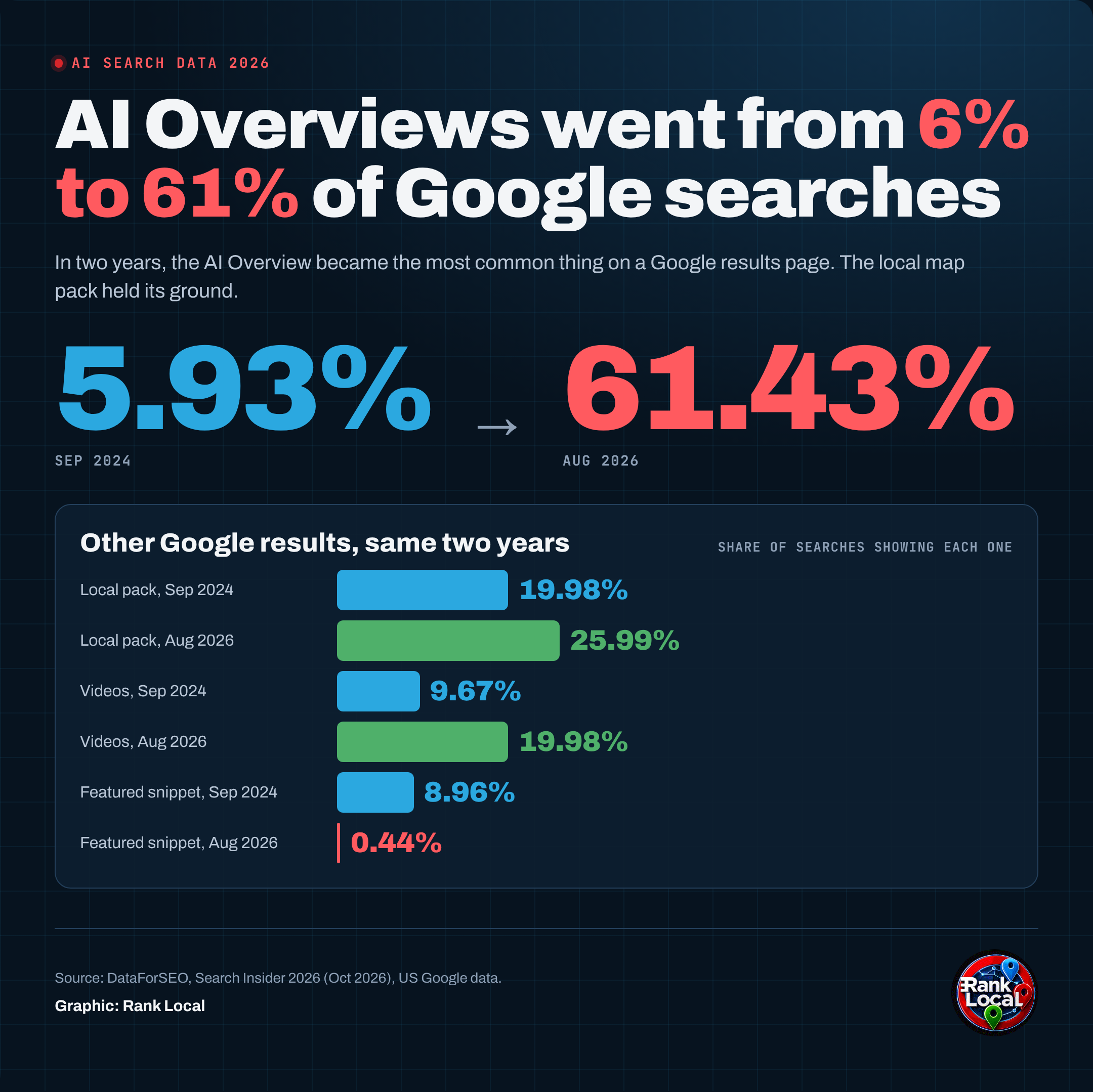 Figure 1: AI Overviews went from 6% to 61% of Google searches in two years, while the local map pack held its ground. Source: DataForSEO, Search Insider 2026, Oct 2026 (US Google, monthly panel, Sep 2024 to Aug 2026). Graphic by Rank Local from that source.
How fast did AI Overviews grow?
- The share of analyzed searches showing an AI Overview rose from 5.93% in September 2024 to 61.43% in August 2026, a tenfold increase (DataForSEO, Search Insider 2026, Oct 2026).
- Across the full keyword set, 56.7% of searches showed an AI Overview (DataForSEO, Search Insider 2026, Oct 2026).
What happened to the rest of the results page?
- Videos doubled, from 9.67% of searches to 19.98% (DataForSEO, Search Insider 2026, Oct 2026).
- Local packs rose from 19.98% to 25.99% (DataForSEO, Search Insider 2026, Oct 2026).
- Discussions and forums fell from 21.13% to 7.42% (DataForSEO, Search Insider 2026, Oct 2026).
- Featured snippets fell from 8.96% to 0.44% (DataForSEO, Search Insider 2026, Oct 2026).
Which searches trigger an AI Overview?
All kinds, and the share is climbing in every group. Commercial searches, where people compare before they buy, grew fastest.
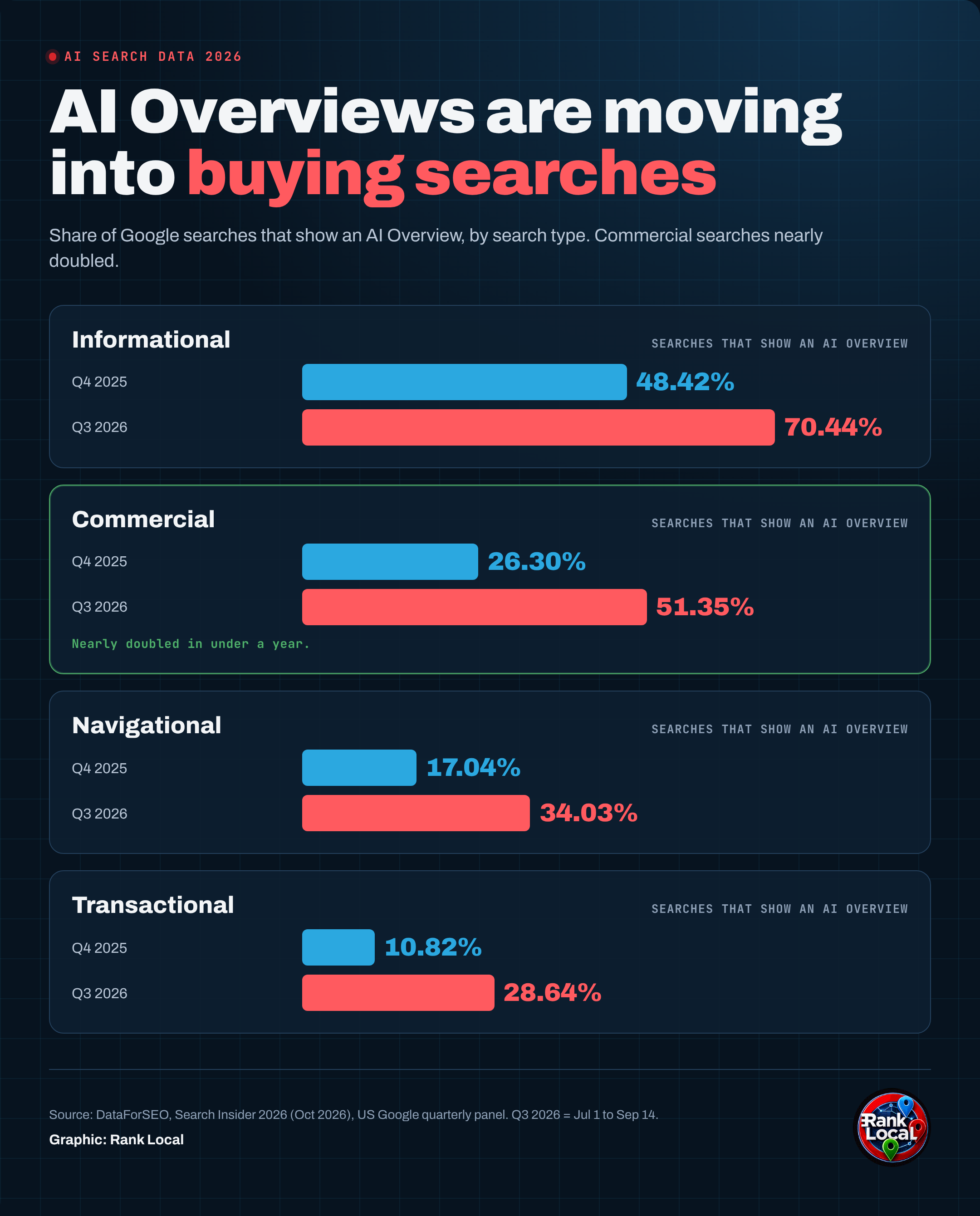 Figure 2: AI Overviews are moving into buying searches. Source: DataForSEO, Search Insider 2026, Oct 2026 (US Google quarterly panel; Q3 2026 covers Jul 1 to Sep 14). Graphic by Rank Local from that source.
By search intent
- Informational searches: 48.42% showed an AI Overview in Q4 2025, 70.44% in Q3 2026 (DataForSEO, Search Insider 2026, Oct 2026).
- Commercial searches: 26.30% to 51.35% (DataForSEO, Search Insider 2026, Oct 2026).
- Navigational searches: 17.04% to 34.03% (DataForSEO, Search Insider 2026, Oct 2026).
- Transactional searches: 10.82% to 28.64% (DataForSEO, Search Insider 2026, Oct 2026).
By search volume, difficulty and cost per click
- Keywords with 201–300 monthly searches showed an AI Overview 58.59% of the time in Q3 2026, up from 33.10%. Keywords with 601+ searches had the lowest rate, 48.62% (DataForSEO, Search Insider 2026, Oct 2026).
- Mid-difficulty keywords (KD 21–60) showed AI Overviews about 65% of the time, easy keywords (KD 1–20) 60.64%, and the hardest (KD 81–100) 53.76% (DataForSEO, Search Insider 2026, Oct 2026).
- Keywords costing $5+ per click showed AI Overviews 49.55% of the time, almost the same as the cheapest keywords ($0–$0.25) at 50.54%. Keywords at $0.51–$1.00 had the lowest rate, 42.63% (DataForSEO, Search Insider 2026, Oct 2026).
By industry
- Health searches showed AI Overviews 69.68% of the time, Finance 68.80% and Family & Community 68.63% (DataForSEO, Search Insider 2026, Oct 2026).
- Home & Garden searches showed AI Overviews 49.28% of the time, below the 56.7% overall rate (DataForSEO, Search Insider 2026, Oct 2026).
- Real Estate had the lowest rate at 22.27%, then Dining & Nightlife at 29.37% and Apparel at 37.48% (DataForSEO, Search Insider 2026, Oct 2026).
What happens to clicks when an AI Overview shows?
The clicks move to the AI answer. Its citations take 42–45% of estimated clicks no matter what kind of search it is, and every organic position on page one loses share.
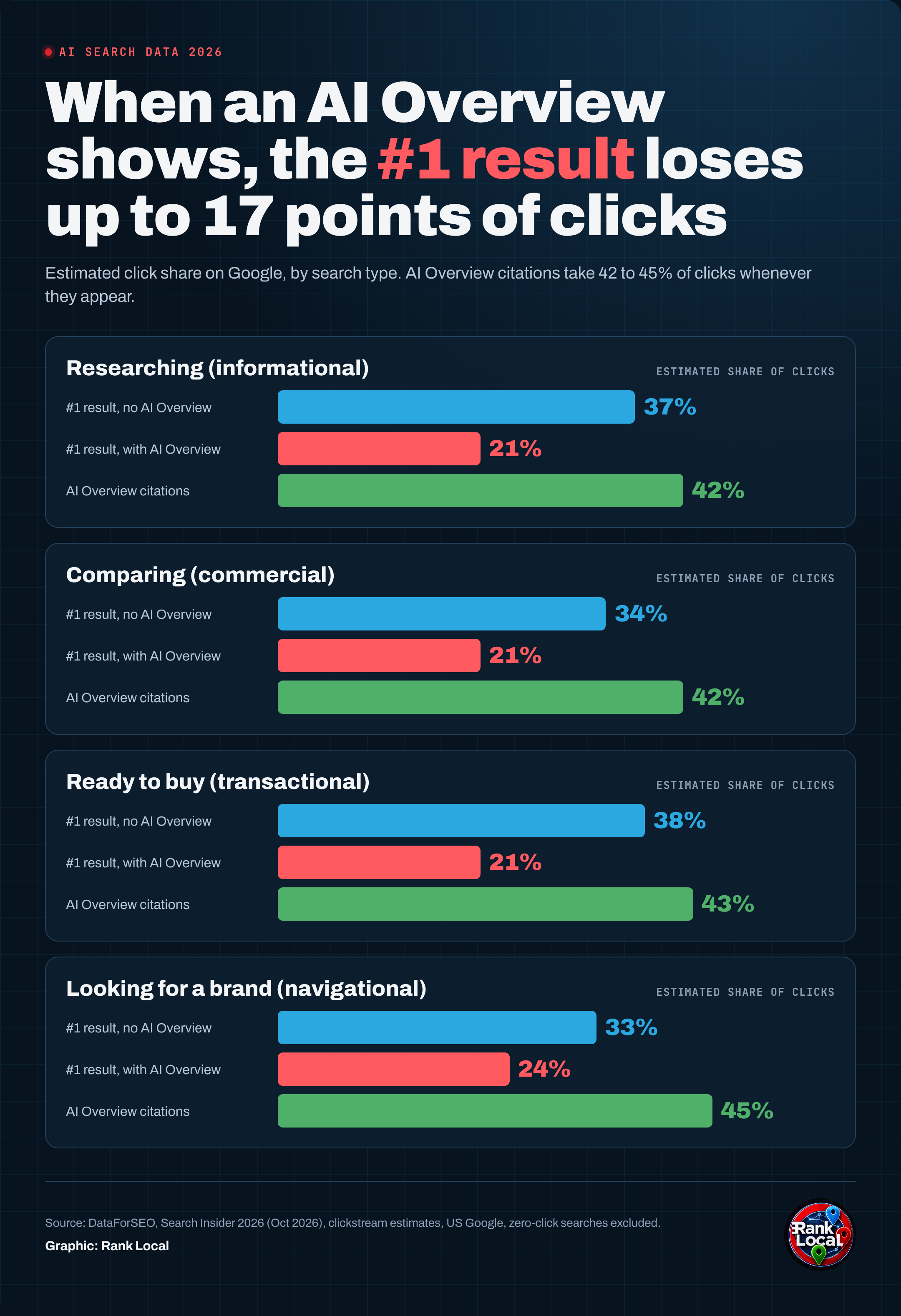 Figure 3: Where clicks go when an AI Overview shows, by type of search. Source: DataForSEO, Search Insider 2026, Oct 2026 (clickstream estimates, US Google, zero-click searches excluded). Graphic by Rank Local from that source.
How much click share does the #1 result lose?
- On informational searches, the #1 result's estimated share falls from 37% to 21% when an AI Overview shows, and AI Overview citations take 42% (DataForSEO, Search Insider 2026, Oct 2026).
- On commercial searches it falls from 34% to 21%, a drop of 12.7 points; citations take 42% (DataForSEO, Search Insider 2026, Oct 2026).
- On transactional searches it falls from 38% to 21%; citations take 43% (DataForSEO, Search Insider 2026, Oct 2026).
- On navigational searches it falls from 33% to 24%, a drop of 9.3 points; citations take 45% (DataForSEO, Search Insider 2026, Oct 2026).
- Positions 2–10 together lose about 36–42% of their estimated click share when an AI Overview appears (DataForSEO, Search Insider 2026, Oct 2026).
Are clicks falling even without AI Overviews?
- From September 2025 to August 2026, desktop click-through rate for position 1 fell from 17.83% to 7.43%, and for position 2 from 15.27% to 3.07% (DataForSEO, Search Insider 2026, Oct 2026).
- Mobile held up better: position 1 fell from 25.17% to 20.80%, and position 2 rose from 7.99% to 8.52% (DataForSEO, Search Insider 2026, Oct 2026).
- The report says this data does not show whether AI answers, layout changes or user behavior caused the drop (DataForSEO, Search Insider 2026, Oct 2026).
Are people searching differently?
- On desktop, searches of five or more words rose from 29.3% to 34.8% of unique queries between September 2025 and August 2026; on mobile, from 29.6% to 31.9% (DataForSEO, Search Insider 2026, Oct 2026).
Which websites get cited in AI answers?
Google's AI Overviews lean on video and community sites. ChatGPT leans on reference sites and publishers. Ranking well in one doesn't mean showing up in the other.
Who gets cited most in Google AI Overviews?
- YouTube was the most-cited site in AI Overviews with 51.9 million citations, more than twice Reddit's 25.1 million (DataForSEO, Search Insider 2026, Oct 2026).
- Facebook (20.4M), Wikipedia (19.9M) and Google (15.9M) completed the top five; six of the top ten were social, video or community sites (DataForSEO, Search Insider 2026, Oct 2026).
Who gets cited most in ChatGPT?
- Wikipedia led ChatGPT citations with 4.88 million citing answers, then Reddit (3.25M), Fandom (670K), Britannica (486K) and NIH (476K) (DataForSEO, Search Insider 2026, Oct 2026).
- YouTube ranked first in AI Overviews but 19th in ChatGPT; Facebook, Instagram and TikTok were in Google's top ten but not ChatGPT's top 30 (DataForSEO, Search Insider 2026, Oct 2026).
- 27.3% of ChatGPT answers cited no source, against 0.7% of Google AI Overview answers (DataForSEO, Search Insider 2026, Oct 2026).
How much does Reddit show up?
- Reddit appeared in Google's top 10 for 32.15% of searches in Q3 2026, nearly eight times Quora's 4.11% (DataForSEO, Search Insider 2026, Oct 2026).
- Reddit's top-10 presence moved by less than three points across four quarters, and its average best position improved from 5.41 to 5.06 (DataForSEO, Search Insider 2026, Oct 2026).
- Reddit was the second most-cited site in both Google AI Overviews and ChatGPT (DataForSEO, Search Insider 2026, Oct 2026).
Do backlinks still matter for rankings and AI citations?
Yes, as far as the data can say. Sites that rank higher and sites that get cited by AI tend to have more referring domains. The report is clear that this is a relationship, not proof that links cause it.
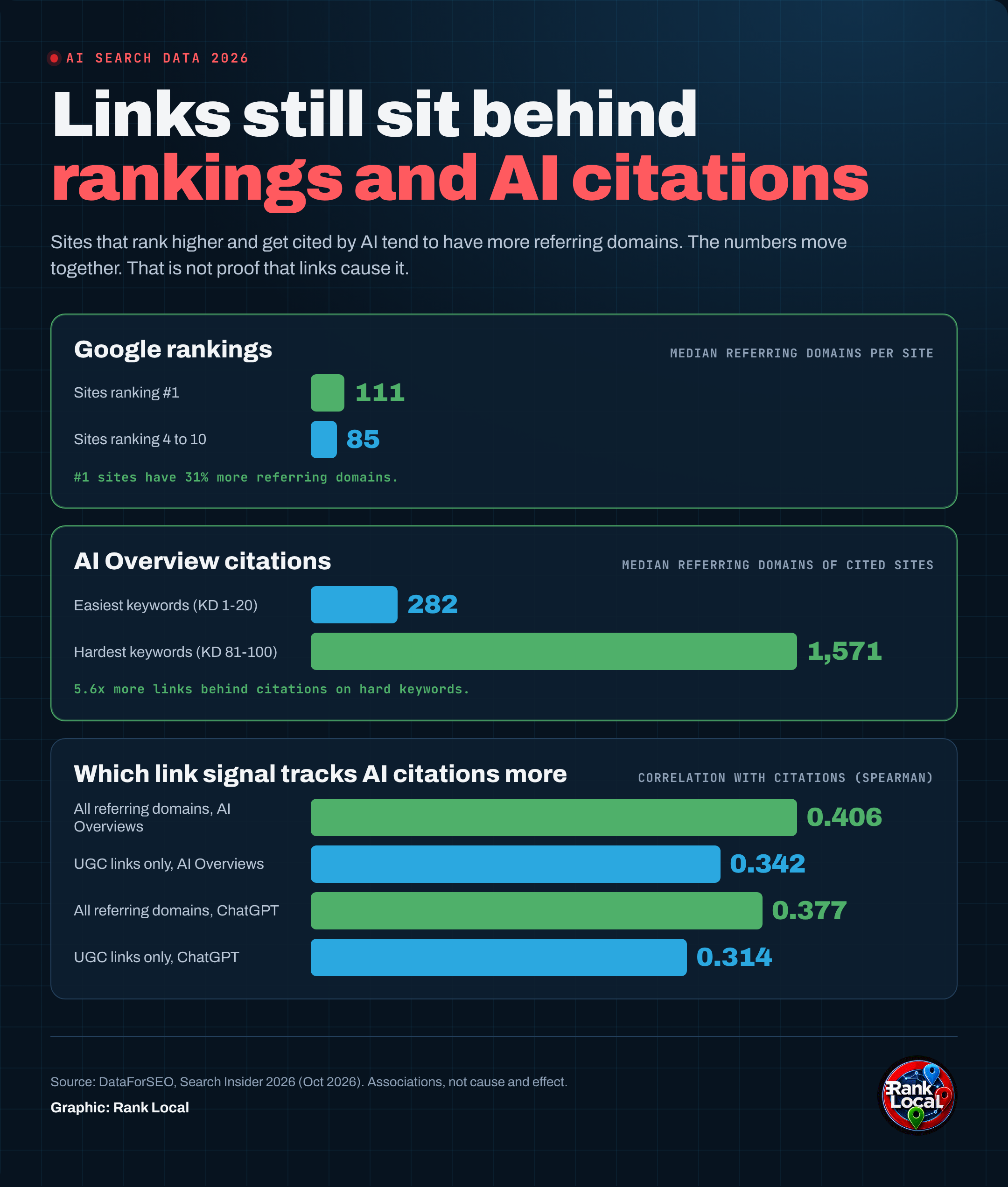 Figure 4: Links still sit behind rankings and AI citations. Source: DataForSEO, Search Insider 2026, Oct 2026 (associations, not cause and effect). Graphic by Rank Local from that source.
Do top-ranking sites have more links?
- Sites ranking #1 had a median of 111 referring domains, against 85 for sites ranking 4 to 10, a 31% difference (DataForSEO, Search Insider 2026, Oct 2026).
- The middle half of #1-ranking sites had 68 to 240 referring domains; for positions 4 to 10 it was 61 to 158 (DataForSEO, Search Insider 2026, Oct 2026).
- At the page level the gap is smaller: a median of 95 referring domains for #1 pages against 84 for positions 4 to 10, a 13% difference (DataForSEO, Search Insider 2026, Oct 2026).
Do AI-cited sites have more links?
- Sites cited in AI Overviews for the hardest keywords (KD 81–100) had a median of 1,571 referring domains, against 282 for the easiest keywords (KD 1–20), a 5.6-fold difference (DataForSEO, Search Insider 2026, Oct 2026).
- Referring domains correlated with AI citations at 0.406 for Google AI Overviews and 0.377 for ChatGPT (Spearman), stronger than UGC links alone at 0.342 and 0.314 (DataForSEO, Search Insider 2026, Oct 2026).
- Among sites with 10,000+ UGC links, 37.6% had 501+ AI Overview citations, against 0.19% of sites with no UGC links (DataForSEO, Search Insider 2026, Oct 2026).
What does this mean for a local business?
This section is Rank Local's reading of the numbers above, not part of the study.
- The map pack is still there. Local packs grew to 25.99% of searches while featured snippets nearly vanished, so a strong Google Business Profile still matters.
- Buying searches now get AI answers too. With half of commercial searches showing an AI Overview, being named in the answer is now part of being found, not only ranking under it.
- Home services see fewer AI Overviews than average. Home & Garden sat at 49.28% against 56.7% overall, which leaves more room for the map pack and organic results in those trades.
- Links and mentions on other sites still count. Higher rankings and more AI citations both go with more referring domains, and Reddit, YouTube and directories are where AI answers often pull from.
Methodology and Sources
Every number on this page comes from DataForSEO's Search Insider 2026 report, published October 2026 and opened on 5 November 2026. DataForSEO sells SEO and AI search data; we cite it as the researcher. The report's search and AI-answer data cover the United States in English: 190.26M keywords with SERP snapshots (June 16 to September 10, 2026), a monthly SERP panel from September 2024 to August 2026, a quarterly panel restricted to keywords with 100+ monthly searches, 137.9M unique Google AI Overview answers, 27.46M unique ChatGPT answers and about 1.14B backlink URLs. Click shares are estimates from clickstream data with zero-click searches excluded. Where the report describes a correlation, we say so; it does not show that links or any other factor cause rankings or citations. The figures are Rank Local graphics built from the report's numbers; we did not reuse the report's charts. This page is reviewed monthly.
Sources
- DataForSEO, Search Insider 2026 (October 2026): https://dataforseo.com/whitepapers/search-insider-2026
Glossary
- AI Overview: the AI-written summary Google shows at the top of some search results.
- Citation (in AI answers): a website the AI answer links to or names as its source.
- Click-through rate (CTR): the share of people who see a result and click it.
- Commercial search: a search made while comparing options before buying, such as "best AC repair company".
- Keyword difficulty (KD): a 1–100 score for how hard it is to rank for a search.
- Local pack (map pack): the box of businesses with a map that Google shows for local searches.
- Referring domain: a separate website that links to yours.
- UGC link: a link from user-generated content such as a forum post or comment, marked rel="ugc".
Share these infographics
Each link has its own graphic preview when shared.